


Page 283 - gas transport in porous media
P. 283
280
                                           Subsurface scenario
                                                              Q (t)                     Rossabi
                                                 patm (t)


                                                          Z
                                             Sand
                                                  Clay
                                          Sand          P
                                               Contaminant  z
                                             Clay
                                         Water table


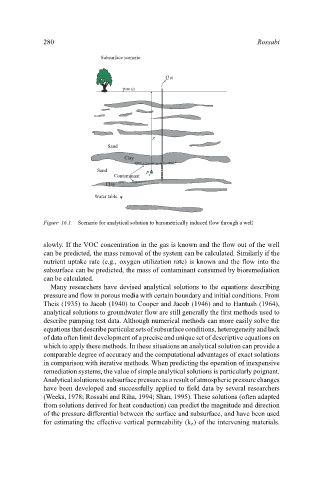
                           Figure 16.1.  Scenario for analytical solution to barometrically induced flow through a well


                           slowly. If the VOC concentration in the gas is known and the flow out of the well
                           can be predicted, the mass removal of the system can be calculated. Similarly if the
                           nutrient uptake rate (e.g., oxygen utilization rate) is known and the flow into the
                           subsurface can be predicted, the mass of contaminant consumed by bioremediation
                           can be calculated.
                             Many researchers have devised analytical solutions to the equations describing
                           pressure and flow in porous media with certain boundary and initial conditions. From
                           Theis (1935) to Jacob (1940) to Cooper and Jacob (1946) and to Hantush (1964),
                           analytical solutions to groundwater flow are still generally the first methods used to
                           describe pumping test data. Although numerical methods can more easily solve the
                           equationsthatdescribeparticularsetsofsubsurfaceconditions, heterogeneityandlack
                           of data often limit development of a precise and unique set of descriptive equations on
                           which to apply these methods. In these situations an analytical solution can provide a
                           comparable degree of accuracy and the computational advantages of exact solutions
                           in comparison with iterative methods. When predicting the operation of inexpensive
                           remediation systems, the value of simple analytical solutions is particularly poignant.
                           Analytical solutions to subsurface pressure as a result of atmospheric pressure changes
                           have been developed and successfully applied to field data by several researchers
                           (Weeks, 1978; Rossabi and Riha, 1994; Shan, 1995). These solutions (often adapted
                           from solutions derived for heat conduction) can predict the magnitude and direction
                           of the pressure differential between the surface and subsurface, and have been used
                           for estimating the effective vertical permeability (k z ) of the intervening materials.

