


Page 285 - gas transport in porous media
P. 285
282
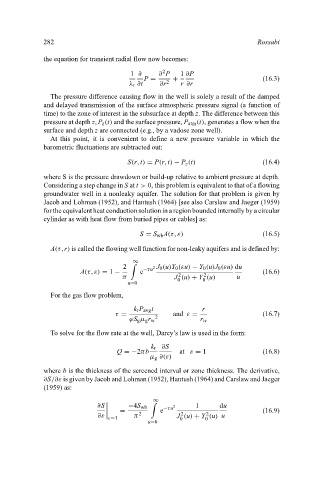
                           the equation for transient radial flow now becomes:
                                                             2
                                                    1 ∂     ∂ P   1 ∂P                  Rossabi
                                                       P =      +                        (16.3)
                                                   λ r ∂t   ∂r 2  r ∂r
                             The pressure difference causing flow in the well is solely a result of the damped
                           and delayed transmission of the surface atmospheric pressure signal (a function of
                           time) to the zone of interest in the subsurface at depth z. The difference between this
                           pressure at depth z, P z (t) and the surface pressure, P atm (t), generates a flow when the
                           surface and depth z are connected (e.g., by a vadose zone well).
                             At this point, it is convenient to define a new pressure variable in which the
                           barometric fluctuations are subtracted out:

                                                   S(r, t) = P(r, t) − P z (t)           (16.4)
                           where S is the pressure drawdown or build-up relative to ambient pressure at depth.
                           Considering a step change in S at t > 0, this problem is equivalent to that of a flowing
                           groundwater well in a nonleaky aquifer. The solution for that problem is given by
                           Jacob and Lohman (1952), and Hantush (1964) [see also Carslaw and Jaeger (1959)
                           for the equivalent heat conduction solution in a region bounded internally by a circular
                           cylinder as with heat flow from buried pipes or cables] as:
                                                      S = S wb A(τ, ε)                   (16.5)

                             A(τ, r) is called the flowing well function for non-leaky aquifers and is defined by:
                                                    ∞

                                                  2    −τu 2 J 0 (u)Y 0 (εu) − Y 0 (u)J 0 (εu) du
                                     A(τ, ε) = 1 −    e                                  (16.6)
                                                                        2
                                                                 2
                                                 π              J (u) + Y (u)     u
                                                                 0
                                                                        0
                                                   u=0
                             For the gas flow problem,
                                                     k r P avg t        r
                                               τ =         2    and ε =                  (16.7)
                                                   ϕS g µ g r w        r w
                             To solve for the flow rate at the well, Darcy’s law is used in the form:
                                                         k r ∂S
                                                Q =−2πb           at ε = 1               (16.8)
                                                         µ g ∂(ε)
                           where b is the thickness of the screened interval or zone thickness. The derivative,
                           ∂S/∂ε is given by Jacob and Lohman (1952), Hantush (1964) and Carslaw and Jaeger
                           (1959) as:
                                                          ∞


                                          ∂S       −4S wb    −τu 2    1      du
                                                 =          e                            (16.9)
                                                                  2
                                                                         2
                                          ∂ε         π 2         J (u) + Y (u) u
                                             ε=1                  0      0
                                                         u=0

