


Page 284 - gas transport in porous media
P. 284
Chapter 16: Analyzing Barometric Pumping
                           The pressure solutions are necessary complements to the analytical flow solution
                           described below.                                                281
                           16.2  PREDICTING SUBSURFACE PRESSURE AND FLOW
                           When the surface and subsurface are connected by a well, the direction and magnitude
                           of the pressure difference between the surface and subsurface determine whether
                           surface air will flow into the formation through the well or soil gas will flow out of
                           the formation. These factors are important when using barometric pumping forces
                           for removal of volatile contaminants from the subsurface, for injection of oxygen and
                           nutrients to enhance bioremediation, and for understanding and interpreting soil gas
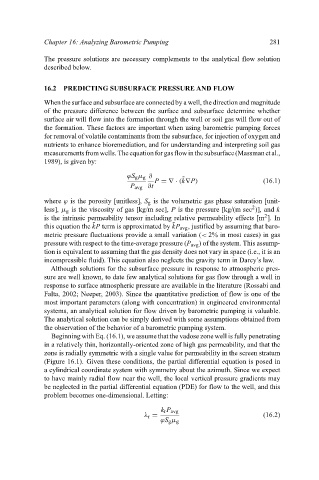
                           measurementsfromwells. Theequationforgasflowinthesubsurface(Massmanetal.,
                           1989), is given by:
                                                   ϕS g µ g ∂
                                                                  ˜
                                                          P =∇ · (k∇P)                   (16.1)
                                                    P avg ∂t
                           where ϕ is the porosity [unitless], S g is the volumetric gas phase saturation [unit-
                                                                                      2
                           less], µ g is the viscosity of gas [kg/m sec], P is the pressure [kg/(m sec )], and k
                                                                                          2
                           is the intrinsic permeability tensor including relative permeability effects [m ]. In
                                                                ˜
                                         ˜
                           this equation the kP term is approximated by kP avg , justified by assuming that baro-
                           metric pressure fluctuations provide a small variation (< 2% in most cases) in gas
                           pressure with respect to the time-average pressure (P avg ) of the system. This assump-
                           tion is equivalent to assuming that the gas density does not vary in space (i.e., it is an
                           incompressible fluid). This equation also neglects the gravity term in Darcy’s law.
                             Although solutions for the subsurface pressure in response to atmospheric pres-
                           sure are well known, to date few analytical solutions for gas flow through a well in
                           response to surface atmospheric pressure are available in the literature (Rossabi and
                           Falta, 2002; Neeper, 2003). Since the quantitative prediction of flow is one of the
                           most important parameters (along with concentration) in engineered environmental
                           systems, an analytical solution for flow driven by barometric pumping is valuable.
                           The analytical solution can be simply derived with some assumptions obtained from
                           the observation of the behavior of a barometric pumping system.
                             Beginning with Eq. (16.1), we assume that the vadose zone well is fully penetrating
                           in a relatively thin, horizontally-oriented zone of high gas permeability, and that the
                           zone is radially symmetric with a single value for permeability in the screen stratum
                           (Figure 16.1). Given these conditions, the partial differential equation is posed in
                           a cylindrical coordinate system with symmetry about the azimuth. Since we expect
                           to have mainly radial flow near the well, the local vertical pressure gradients may
                           be neglected in the partial differential equation (PDE) for flow to the well, and this
                           problem becomes one-dimensional. Letting:

                                                            k r P avg
                                                       λ r =                             (16.2)
                                                            ϕS g µ g

