


Page 290 - gas transport in porous media
P. 290
Chapter 16: Analyzing Barometric Pumping
                              Table 16.4. List of input parameters for model Baroflow
                              Porosity = 0.4         Well radius = 1.27 cm                 287
                              Gas phase saturation (S g ) = 0.9  Permeable zone thickness = 30 cm (screen length)
                              Average pressure = 100.4 kPa  Calibrated radial permeability (k r ) = 40 E-12 m  2
                              Differential pressure data continuously logged at 10 minute intervals from 3/18/94 to 4/25/94.


                                                Comparison of measured and modeled flow data
                                                     (Using differential pressure data)
                                  25
                                       kr = 40 Darcy
                                  20
                                  15

                                  10
                                   5
                                Flow (lpm)  -5 0


                                  -10

                                  -15
                                                                                Field data
                                  -20
                                                                                Differ. P model
                                  -25
                                    0           5          10          15         20
                                                          Time (days)

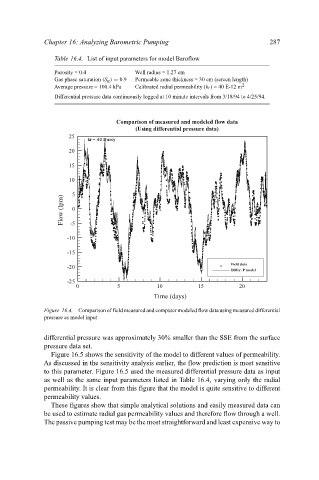
                           Figure 16.4.  Comparison of field measured and computer modeled flow data using measured differential
                           pressure as model input


                           differential pressure was approximately 30% smaller than the SSE from the surface
                           pressure data set.
                             Figure 16.5 shows the sensitivity of the model to different values of permeability.
                           As discussed in the sensitivity analysis earlier, the flow prediction is most sensitive
                           to this parameter. Figure 16.5 used the measured differential pressure data as input
                           as well as the same input parameters listed in Table 16.4, varying only the radial
                           permeability. It is clear from this figure that the model is quite sensitive to different
                           permeability values.
                             These figures show that simple analytical solutions and easily measured data can
                           be used to estimate radial gas permeability values and therefore flow through a well.
                           The passive pumping test may be the most straightforward and least expensive way to

