


Page 207 - Geochemical Remote Sensing of The Sub-Surface
P. 207
184                                     V.T. Jones,  M.D.  Matthews and D.M.  Richers
                                Lineament Center

                9  ..,h ...ue    ///                 B
                  Station
                 Background     x  /
               x   Station   /x    x/
              /   Fracture /,/~X//r


                                               Distance  from
                                              Lineament  canter ~

                                           t


            /                              i  oOoo o"'o"'"
                                             ,.;o.  ".-;"
                                               Distance  from
                                              Lineament  center v
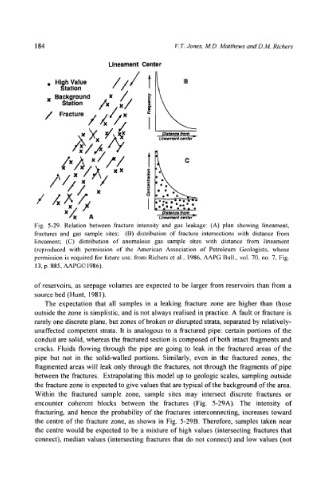
           Fig.  5-29. Relation  between  fracture  intensity  and  gas  leakage:  (A)  plan  showing  lineament,
           fractures  and  gas  sample  sites;  (B)  distribution  of  fracture  intersections  with  distance  from
           lineament;  (C)  distribution  of  anomalous  gas  sample  sites  with  distance  from  lineament
           (reproduced  with  permission  of  the  American  Association  of  Petroleum  Geologists,  whose
           permission  is required  for future use, from Richers  et al.,  1986, AAPG  Bull.,  vol. 70,  no.  7,  Fig.
           13, p. 885, AAPG 9 1986).


           of reservoirs,  as  seepage  volumes  are  expected  to  be  larger  from  reservoirs  than  from  a
           source  bed (Hunt,  1981).
              The  expectation  that  all  samples  in  a  leaking  fracture  zone  are  higher  than  those
           outside  the  zone  is simplistic,  and  is not always realised  in practice.  A  fault or  fracture  is
           rarely one discrete  plane,  but zones  of broken  or disrupted  strata,  separated  by relatively-
           unaffected  competent  strata.  It  is  analogous  to  a  fractured  pipe:  certain  portions  of the
           conduit are  solid,  whereas the  fractured  section  is composed  of both  intact fragments  and
           cracks.  Fluids  flowing  through  the  pipe  are  going  to  leak  in  the  fractured  areas  of the
           pipe  but  not  in  the  solid-walled  portions.  Similarly,  even  in  the  fractured  zones,  the
           fragmented  areas  will  leak only through  the  fractures,  not  through  the  fragments  of pipe
           between  the  fractures.  Extrapolating  this  model  up to  geologic  scales,  sampling  outside
           the fracture  zone  is expected to give values that are typical of the background  of the  area.
           Within  the  fractured  sample  zone,  sample  sites  may  intersect  discrete  fractures  or
           encounter  coherent  blocks  between  the  fractures  (Fig.  5-29A).  The  intensity  of
           fracturing,  and  hence  the  probability  of the  fractures  interconnecting,  increases  toward
           the  centre  of the  fracture  zone,  as  shown  in  Fig.  5-29B.  Therefore,  samples  taken  near
           the  centre  would  be  expected  to  be  a  mixture  of high  values  (intersecting  fractures  that
           connect),  median  values  (intersecting  fractures  that  do  not  connect)  and  low  values  (not

