


Page 211 - Geochemical Remote Sensing of The Sub-Surface
P. 211
188                                     V.T. Jones,  M.D.  Matthews and D.M.  Richers
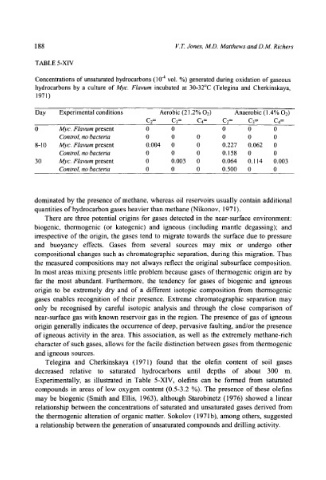
           TABLE 5-XlV

           Concentrations  of unsaturated  hydrocarbons  (10 -4 vol.  %) generated  during  oxidation  of gaseous
           hydrocarbons  by a  culture  of Myc.  Flavum  incubated  at  30-32~  (Telegina  and  Cherkinskaya,
           1971)

           Day    Experimental conditions     Aerobic (21.2% O2)   Anaerobic (1.4% 02)
                                          C2 =    C3--   Ca--   C2--   C3=    Ca =
           0      Myc. Flavum present     0       0             0      0      0
                  Control no bacteria     0       0      0      0      0      0
           8-10   Myc.  Flavum present    0.004   0      0      0.227   0.062   0
                  Control no bacteria     0       0      0      0.158   0     0
           30     Myc.  Flavum present    0       0.003   0     0.064   0.114   0.003
                  Control no bacteria     0       0      0      0.500   0     0


           dominated  by the presence  of methane,  whereas  oil  reservoirs  usually contain  additional
           quantities of hydrocarbon gases heavier than methane (Nikonov,  1971).
              There  are  three  potential  origins  for gases  detected  in the  near-surface  environment:
           biogenic,  thermogenic  (or  katogenic)  and  igneous  (including  mantle  degassing);  and
           irrespective  of the  origin,  the  gases  tend  to  migrate  towards  the  surface  due  to  pressure
           and  buoyancy  effects.  Gases  from  several  sources  may  mix  or  undergo  other
           compositional  changes  such  as  chromatographic  separation,  during  this  migration.  Thus
           the  measured  compositions  may  not  always  reflect  the  original  subsurface  composition.
           In most areas  mixing presents  little  problem  because  gases of thermogenic  origin  are  by
           far  the  most  abundant.  Furthermore,  the  tendency  for  gases  of  biogenic  and  igneous
           origin  to  be  extremely  dry  and  of  a  different  isotopic  composition  from  thermogenic
           gases  enables  recognition  of  their  presence.  Extreme  chromatographic  separation  may
           only  be  recognised  by  careful  isotopic  analysis  and  through  the  close  comparison  of
           near-surface  gas with known  reservoir gas  in the  region.  The  presence  of gas of igneous
           origin generally indicates the occurrence  of deep,  pervasive  faulting,  and/or the presence
           of igneous  activity  in  the  area.  This  association,  as  well  as  the  extremely  methane-rich
           character of such gases, allows  for the  facile distinction between  gases from thermogenic
           and igneous  sources.
              Telegina  and  Cherkinskaya  (1971)  found  that  the  olefin  content  of  soil  gases
           decreased  relative  to  saturated  hydrocarbons  until  depths  of  about  300  m.
           Experimentally,  as  illustrated  in  Table  5-XIV,  olefins  can  be  formed  from  saturated
           compounds  in  areas  of low  oxygen  content  (0.5-3.2  %).  The  presence  of these  olefins
           may be  biogenic  (Smith  and  Ellis,  1963),  although  Starobinetz  (1976)  showed  a  linear
           relationship  between  the  concentrations  of saturated  and unsaturated  gases  derived  from
           the  thermogenic  alteration  of organic  matter.  Sokolov  (1971 b),  among  others,  suggested
           a relationship  between the generation of unsaturated  compounds  and drilling activity.

