


Page 213 - Geochemical Remote Sensing of The Sub-Surface
P. 213
190                                     V.T. Jones, M.D.  Matthews and D.M. Richers
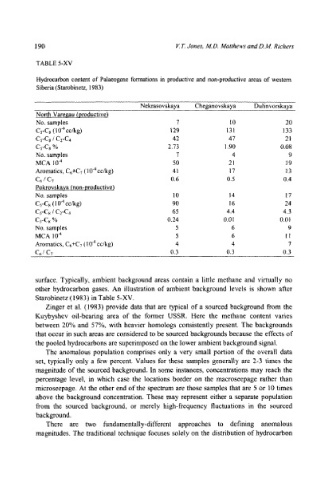
           TABLE 5-XV

           Hydrocarbon content of Palaeogene formations in productive and non,productive areas of western
           Siberia (Starobinetz, 1983)

                                         Nekrasovskaya   Cheganovskaya   Dulinvorskaya
           Nort_h Varegau (productive)
           No. samples                             7              10              20
           C~-C8 (I 0 "4 cc/kg)                  129             131             133
           C5-Cs / Cz-C4                          42              47              21
           Cs-Cs %                               2.73            1.90           0.08
           No. samples                             7               4               9
           MCA l 0 "4                             50              21              19
           Aromatics, C6+C7 (I 0 4 cc/kg)         41              17              13
           C6 / C7                               0.6             0.5             0.4
           Pokrpvskaya (non-productive)
           No. samples                            10              14              17
           C5-C~ (10 "4 cc/kg)                    90              16             24
           Cs-Cs / C2-C4                          65             4.4             4.3
           Cs-Cs %                              0.24            0,01            0.01
           No. samples                             5              6               9
           MCA 10 -4                               5              6               11
           Aromatics, C6+C7 (10 .4 cc/kg)          4              4               7
           C6 / C7                               0.3             0.3             0.3


           surface.  Typically,  ambient  background  areas  contain  a  little  methane  and  virtually  no
           other  hydrocarbon  gases.  An  illustration  of  ambient  background  levels  is  shown  after
           Starobinetz (1983) in Table 5-XV.
              Zinger et  al.  (1983)  provide  data  that  are  typical  of a  sourced  background  from  the
           Kuybyshev  oil-bearing  area  of  the  former  USSR.  Here  the  methane  content  varies
           between  20%  and  57%,  with  heavier  homologs  consistently  present.  The  backgrounds
           that occur in such areas are considered to be sourced backgrounds because the effects of
           the pooled hydrocarbons are superimposed on the lower ambient background signal.
              The  anomalous  population  comprises  only  a  very  small  portion  of the  overall  data
           set,  typically only  a  few  percent.  Values  for these  samples  generally  are  2-3  times  the
           magnitude  of the  sourced background.  In some  instances,  concentrations  may reach  the
           percentage  level,  in  which  case  the  locations  border  on  the  macroseepage  rather  than
           microseepage.  At the other end of the spectrum are those  samples that are  5 or  10 times
           above  the  background  concentration.  These  may represent  either  a  separate  population
           from  the  sourced  background,  or  merely  high-frequency  fluctuations  in  the  sourced
           background.
              There  are  two  fundamentally-different  approaches  to  defining  anomalous
           magnitudes.  The  traditional  technique  focuses  solely on the  distribution of hydrocarbon

