


Page 209 - Geochemical Remote Sensing of The Sub-Surface
P. 209
186                                     V.T. Jones,  M.D.  Matthews and D.M.  Richers


                                                       4
                                                        E
                                                        Q.
                                                        O.
                                                       3
                                                        LU
                                                        Z
                                                        <C
                                                       2~
                                                        rr
                                                        Q.
                                                       I
                                ,                      0
                 SOUTH    WHIP  COVE          WEST  LIMB
              40~176    EAST  ANTICLINE   NW--"  HANGING  ROCK
                 .~        No. 9254           ANTICLINE
                                                LOST
              2000,  ," ~   ~   ~              RIVER
            z
            g   0
            >-2000
            W
            W
             -4000'
             -6000   Oriskany Sandstone         g
                              VERTICAL  EXAGERAT)ON  2:1   Metws
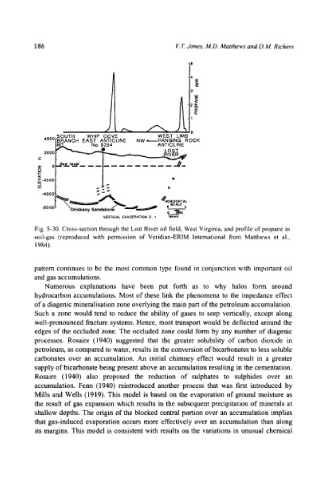
           Fig. 5-30. Cross-section through the Lost River oil field, West Virginia, and profile of propane in
           soil-gas  (reproduced  with permission of  Veridian-ERIM International from Matthews et  al.,
           1984).


           pattern  continues  to  be  the  most  common  type  found  in  conjunction  with  important  oil
           and gas accumulations.
              Numerous  explanations  have  been  put  forth  as  to  why  halos  form  around
           hydrocarbon  accumulations.  Most  of these  link  the  phenomena  to  the  impedance  effect
           of a diagenic mineralisation zone overlying the main part of the petroleum accumulation.
           Such  a  zone  would  tend  to  reduce  the  ability  of gases  to  seep  vertically,  except  along
           well-pronounced  fracture  systems.  Hence,  most transport  would be  deflected  around  the
           edges  of the  occluded  zone.  The  occluded  zone  could  form by  any  number  of diagenic
           processes.  Rosaire  (1940)  suggested  that  the  greater  solubility  of  carbon  dioxide  in
           petroleum,  as compared to water,  results in the conversion of bicarbonates to less soluble
           carbonates  over  an  accumulation.  An  initial  chimney  effect  would  result  in  a  greater
           supply of bicarbonate being present above an accumulation resulting in the cementation.
           Rosaire  (1940)  also  proposed  the  reduction  of  sulphates  to  sulphides  over  an
           accumulation.  Fenn  (1940)  reintroduced  another  process  that  was  first  introduced  by
           Mills  and  Wells  (1919).  This  model  is  based  on  the  evaporation  of ground  moisture  as
           the  result  of gas  expansion  which  results  in  the  subsequent  precipitation  of minerals  at
           shallow depths.  The  origin of the blocked  central  portion over  an accumulation  implies
           that  gas-induced  evaporation  occurs  more  effectively  over  an  accumulation  than  along
           its margins.  This  model  is consistent  with  results  on the  variations  in unusual  chemical

