


Page 216 - Geochemical Remote Sensing of The Sub-Surface
P. 216
Light hydrocarbons for petroleum and gas prospecting                 193


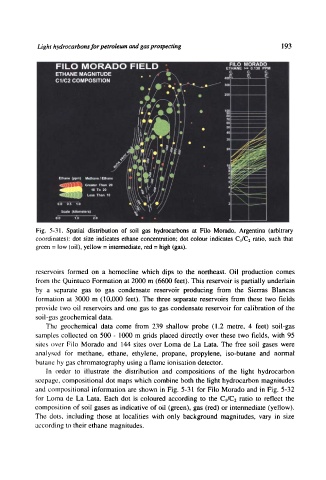
           Fig.  5-31.  Spatial  distribution  of  soil gas  hydrocarbons  at  Filo  Morado,  Argentina  (arbitrary
           coordinates):  dot  size  indicates ethane  concentration;  dot colour indicates  CI/C2 ratio,  such  that
           green = low (oil), yellow = intermediate,  red = high (gas).


           reservoirs  formed  on  a  homocline  which  dips  to  the  northeast.  Oil  production  comes
           from  the  Quintuco  Formation at 2000  m  (6600  feet).  This  reservoir is partially  underlain
           by  a  separate  gas  to  gas  condensate  reservoir  producing  from  the  Sierras  Blancas
           formation  at  3000  m  (10,000  feet).  The  three  separate  reservoirs  from  these  two  fields
           provide  two  oil  reservoirs  and  one  gas  to  gas  condensate  reservoir  for calibration  of the
           soil-gas  geochemical  data.
              The  geochemical  data  come  from  239  shallow  probe  (1.2  metre,  4  feet)  soil-gas
           samples  collected  on  500  -  1000  m  grids  placed  directly  over  these  two  fields,  with  95
           sites  over  Filo  Morado  and  144  sites  over  Loma  de  La  Lata.  The  free  soil  gases  were
           analysed  for  methane,  ethane,  ethylene,  propane,  propylene,  iso-butane  and  normal
           butanc  by gas chromatography  using a flame ionisation detector.
              In  order  to  illustrate  the  distribution  and  compositions  of  the  light  hydrocarbon
           seepage,  compositional  dot  maps  which combine  both  the  light  hydrocarbon  magnitudes
           and  compositional  information  are  shown  in Fig.  5-31  for Filo  Morado  and  in  Fig.  5-32
           for  Loma  de  La  Lata.  Each  dot  is  coloured  according  to  the  C~/C2 ratio  to  reflect  the
           composition  of soil  gases  as  indicative  of oil  (green),  gas  (red)  or intermediate  (yellow).
           The  dots,  including  those  at  localities  with  only  background  magnitudes,  vary  in  size
           according to their ethane  magnitudes.

