


Page 217 - Geochemical Remote Sensing of The Sub-Surface
P. 217
194                                     V.T. Jones,  M.D. Matthews and D.M.  Richers


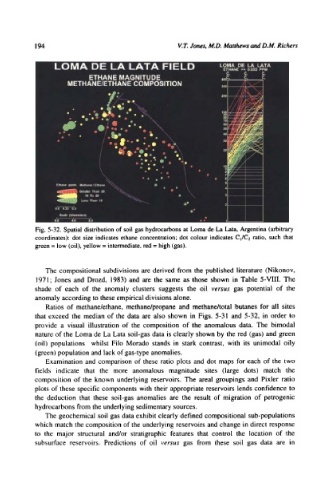
           Fig. 5-32. Spatial distribution of soil gas hydrocarbons  at Loma de La Lata, Argentina (arbitrary
           coordinates):  dot size indicates ethane concentration;  dot colour indicates CJC2  ratio, such  that
           green = low (oil), yellow = intermediate, red = high (gas).


              The  compositional  subdivisions  are  derived  from  the  published  literature  (Nikonov,
           1971;  Jones  and  Drozd,  1983)  and  are  the  same  as  those  shown  in  Table  5-VIII.  The
           shade  of  each  of  the  anomaly  clusters  suggests  the  oil  versus  gas  potential  of  the
           anomaly according to these empirical divisions alone.
              Ratios  of  methane/ethane,  methane/propane  and  methane/total  butanes  for  all  sites
           that  exceed  the  median  of the  data  are  also  shown  in  Figs.  5-31  and  5-32,  in  order  to
           provide  a  visual  illustration  of  the  composition  of  the  anomalous  data.  The  bimodal
           nature  of the  Loma de  La Lata soil-gas data  is clearly  shown  by  the  red  (gas)  and  green
           (oil)  populations  whilst  Filo  Morado  stands  in  stark  contrast,  with  its  unimodal  oily
           (green) population and lack of gas-type anomalies.
              Examination  and  comparison  of these  ratio  plots  and  dot  maps  for  each  of  the  two
           fields  indicate  that  the  more  anomalous  magnitude  sites  (large  dots)  match  the
           composition  of  the  known  underlying  reservoirs.  The  areal  groupings  and  Pixler  ratio
           plots  of these  specific  components  with  their  appropriate  reservoirs  lends  confidence  to
           the  deduction  that  these  soil-gas  anomalies  are  the  result  of  migration  of  petrogenic
           hydrocarbons from the underlying sedimentary sources.
              The  geochemical  soil gas data exhibit clearly defined  compositional  sub-populations
           which  match  the composition of the  underlying reservoirs  and change  in direct response
           to  the  major  structural  and/or  stratigraphic  features  that  control  the  location  of  the
           subsurface  reservoirs.  Predictions  of  oil  versus  gas  from  these  soil  gas  data  are  in

