


Page 202 - Geochemical Remote Sensing of The Sub-Surface
P. 202
Light hydrocarbons for petroleum and gas prospecting                  179


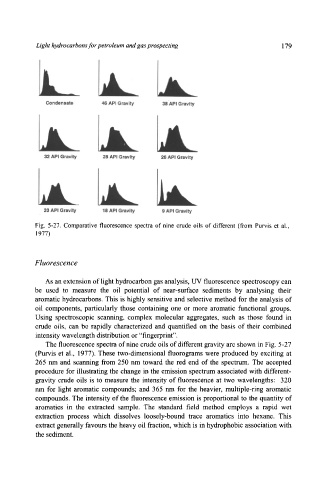
           Fig. 5-27. Comparative  fluorescence  spectra  of nine  crude  oils  of different  (from  Purvis  et  al.,
           1977)


           Fluorescence

              As an extension of light hydrocarbon gas analysis, UV  fluorescence  spectroscopy can
           be  used  to  measure  the  oil  potential  of  near-surface  sediments  by  analysing  their
           aromatic  hydrocarbons.  This  is highly sensitive  and  selective  method  for the  analysis  of
           oil  components,  particularly  those  containing  one  or  more  aromatic  functional  groups.
           Using  spectroscopic  scanning,  complex  molecular  aggregates,  such  as  those  found  in
           crude  oils,  can  be  rapidly  characterized  and  quantified  on  the  basis  of  their  combined
           intensity wavelength distribution or "fingerprint".
              The fluorescence  spectra of nine crude oils of different gravity are shown  in Fig.  5-27
           (Purvis  et  al.,  1977).  These  two-dimensional  fluorograms  were  produced  by  exciting  at
           265  nm  and  scanning  from  250  nm  toward  the  red  end  of the  spectrum.  The  accepted
           procedure  for  illustrating  the  change  in the  emission  spectrum  associated  with  different-
           gravity  crude  oils  is  to  measure  the  intensity  of fluorescence  at  two  wavelengths:  320
           nm  for  light  aromatic  compounds;  and  365  nm  for  the  heavier,  multiple-ring  aromatic
           compounds.  The  intensity of the  fluorescence  emission  is proportional  to the  quantity of
           aromatics  in  the  extracted  sample.  The  standard  field  method  employs  a  rapid  wet
           extraction  process  which  dissolves  loosely-bound  trace  aromatics  into  hexane.  This
           extract generally favours the heavy oil fraction,  which is in hydrophobic  association  with
           the sediment.

