


Page 199 - Geochemical Remote Sensing of The Sub-Surface
P. 199
176                                     V.T. Jones,  M.D. Matthews and D.M. Richers

           correlation  among  the  gases  may  reflect  a  near-equilibrium  condition  achieved  through
           time  for  the  adsorption-desorption  process  in  soils.  Hence,  the  signal  seen  by  the
           desorption  technique  may  effectively  integrate  and  smooth  rapid  changes  one  might
           expect to see with a free-gas technique  such as auger holes.
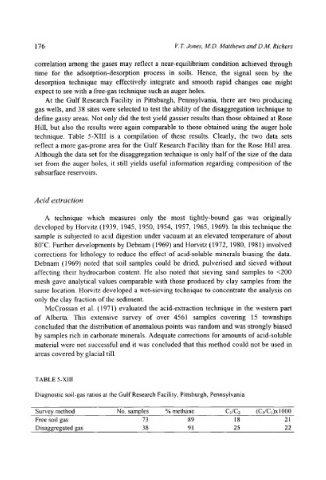
              At  the  Gulf Research  Facility  in  Pittsburgh,  Pennsylvania,  there  are  two  producing
           gas wells, and 38  sites were selected to test the ability of the disaggregation technique to
           define  gassy areas. Not only did the test yield gassier results than those obtained at Rose
           Hill,  but  also  the  results  were  again  comparable  to  those  obtained  using  the  auger hole
           technique.  Table  5-XIII  is  a  compilation  of  these  results.  Clearly,  the  two  data  sets
           reflect  a more gas-prone  area for the  Gulf Research  Facility than  for the  Rose  Hill  area.
           Although the data set for the disaggregation technique  is only half of the  size of the data
           set  from  the  auger holes,  it  still  yields  useful  information  regarding  composition  of the
           subsurface reservoirs.


           Acid  extraction

              A  technique  which  measures  only  the  most  tightly-bound  gas  was  originally
           developed by Horvitz (1939,  1945,  1950,  1954,  1957,  1965,  1969).  In this technique  the
           sample  is subjected  to  acid  digestion under vacuum  at an elevated  temperature  of about
           80~  Further developments by Debnam (1969) and Horvitz (1972,  1980,  1981) involved
           corrections  for  lithology  to  reduce  the  effect  of acid-soluble  minerals  biasing  the  data.
           Debnam  (1969)  noted  that  soil  samples  could  be  dried,  pulverised  and  sieved  without
           affecting  their  hydrocarbon  content.  He  also  noted  that  sieving  sand  samples  to  <200
           mesh  gave  analytical  values  comparable  with  those  produced  by  clay  samples  from  the
           same  location.  Horvitz developed a wet-sieving technique  to concentrate  the  analysis on
           only the clay fraction of the sediment.
              McCrossan  et  al.  (1971)  evaluated  the  acid-extraction  technique  in  the  western  part
           of  Alberta.  This  extensive  survey  of  over  4561  samples  covering  15  townships
           concluded that the distribution of anomalous points was random and was strongly biased
           by samples rich  in carbonate minerals.  Adequate  corrections  for amounts of acid-soluble
           material  were  not successful  and it was  concluded that this method could not be used  in
           areas covered by glacial till.


           TABLE 5-XIII

           Diagnostic soil-gas ratios at the Gulf Research Facility, Pittsburgh, Pennsylvania

           Survey method          No. samples   % methane        CI/C 2   (C3/CI)XI000
           Free soil gas                 73           89           18            21
           Disaggregated gas             38           91           25            22

