


Page 194 - Geochemical Remote Sensing of The Sub-Surface
P. 194
Light hydrocarbons for petroleum and gas prospecting                  171


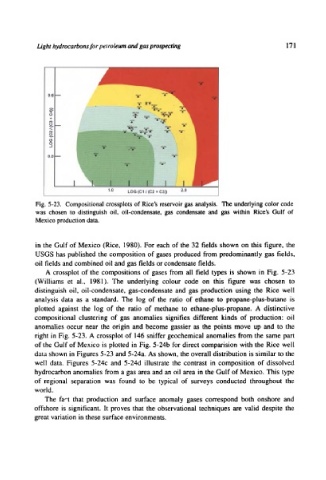
           Fig. 5-23.  Compositional crossplots of Rice's reservoir gas analysis.  The underlying color code
           was  chosen to  distinguish  oil, oil-condensate,  gas  condensate  and  gas  within  Rice's  Gulf  of
           Mexico production data.


           in  the  Gulf of Mexico  (Rice,  1980).  For each  of the  32  fields  shown  on  this  figure,  the
           USGS  has published  the  composition  of gases produced  from  predominantly  gas  fields,
           oil fields and combined oil and gas fields or condensate fields.
              A  crossplot  of the  compositions  of gases  from  all  field  types  is  shown  in  Fig.  5-23
           (Williams  et  al.,  1981).  The  underlying  colour  code  on  this  figure  was  chosen  to
           distinguish  oil,  oil-condensate,  gas-condensate  and  gas  production  using  the  Rice  well
           analysis  data  as  a  standard.  The  log  of  the  ratio  of  ethane  to  propane-plus-butane  is
           plotted  against  the  log  of  the  ratio  of  methane  to  ethane-plus-propane.  A  distinctive
           compositional  clustering  of  gas  anomalies  signifies  different  kinds  of  production:  oil
           anomalies  occur  near  the  origin  and  become  gassier  as  the  points  move  up  and  to  the
           right  in Fig. 5-23.  A crossplot of  146 sniffer geochemical  anomalies  from  the  same  part
           of the  Gulf of Mexico  is plotted  in  Fig.  5-24b  for direct comparision  with  the  Rice  well
           data shown in Figures 5-23 and 5-24a.  As shown, the overall distribution  is similar to the
           well  data.  Figures  5-24c  and  5-24d  illustrate  the  contrast  in  composition  of  dissolved
           hydrocarbon anomalies  from a gas area and an oil area  in the Gulf of Mexico.  This  type
           of  regional  separation  was  found  to  be  typical  of  surveys  conducted  throughout  the
           world.
              The  fa'-t  that  production  and  surface  anomaly  gases  correspond  both  onshore  and
           offshore  is  significant.  It  proves  that  the  observational  techniques  are  valid  despite  the
           great variation in these surface environments.

