


Page 192 - Geochemical Remote Sensing of The Sub-Surface
P. 192
Light hydrocarbons for petroleum and gas prospecting                  169

           TABLE 5-XI

           Composition ratios of soil-gas hydrocarbons over Pleasant Creek gas storage area

           Date                               C1/Cn           CI/C2       (C3/CI)x 1000
           May 1975                             90              20                19
           July 1975                            89              18                24
           July 1976                            89              16                20


           a chromatographic effect would be expected for gas that migrated through the Earth.  The
           fact  that  the  compositions  of the  soil-gas  data  from  auger  holes  match  the  underlying
           reservoirs confirms that the  major migration mechanism to the  near-surface  must be  via
           faults and fractures, rather than by diffusion.
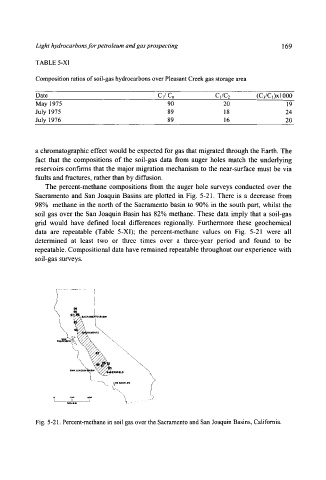
              The  percent-methane  compositions  from the  auger  hole  surveys  conducted  over  the
           Sacramento  and  San  Joaquin  Basins  are  plotted  in  Fig.  5-21.  There  is  a  decrease  from
           98%  methane  in the  north of the  Sacramento  basin  to 90%  in the  south part,  whilst  the
           soil  gas  over the  San Joaquin  Basin  has  82%  methane.  These  data  imply that  a  soil-gas
           grid  would  have  defined  local  differences  regionally.  Furthermore  these  geochemical
           data  are  repeatable  (Table  5-XI);  the  percent-methane  values  on  Fig.  5-21  were  all
           determined  at  least  two  or  three  times  over  a  three-year  period  and  found  to  be
           repeatable.  Compositional data have remained repeatable throughout our experience  with
           soil-gas surveys.


                                 L-...,    f


           Fig. 5-21. Percent-methane in soil gas over the Sacramento and San Joaquin Basins, California.

