


Page 187 - Geochemical Remote Sensing of The Sub-Surface
P. 187
164                                    V.T. Jones,  M.D.  Matthews and D.M. Richers

                                               CHARCOAL TRAP
                                                   RADON
                         IR DETECTOR
                                                                 Amblerd Air
                            CO 2                                   Inlal

                                                                      -
                          DUAL GAS                RECORDER
                       CHROMATOGRAPH             INTEGRATOR
                       l~  - C4 Hydrocarbon   j
            Pneumatic
             Valves
               &            II  Flame \\  Carrier
             Flame
            Ionization      II  ton o \\  Gas
            Detector       ~ect r ~  II i PUvl,,~                I! Lxx\'\'\\\'''''~
             Support
                           I,LI    2.1

                                                          <


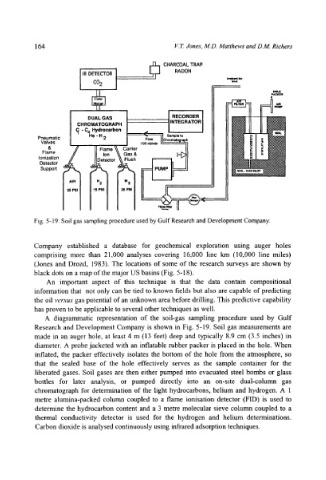
           Fig. 5-19. Soil gas sampling procedure used by Gulf Research and Development Company.


           Company  established  a  database  for  geochemical  exploration  using  auger  holes
           comprising  more  than  21,000  analyses  covering  16,000  line  km  (10,000  line  miles)
           (Jones  and  Drozd,  1983).  The  locations  of some  of the  research  surveys  are  shown  by
           black dots on a map of the major US basins (Fig. 5-18).
              An  important  aspect  of  this  technique  is  that  the  data  contain  compositional
           information that  not only can be tied  to known fields but  also  are  capable  of predicting
           the oil versus  gas potential of an unknown area before drilling.  This predictive  capability
           has proven to be applicable to several other techniques as well.
              A  diagrammatic  representation  of  the  soil-gas  sampling  procedure  used  by  Gulf
           Research  and  Development Company  is shown  in Fig.  5-19.  Soil  gas measurements  are
           made  in  an  auger hole,  at  least 4  m  (13  feet)  deep  and  typically  8.9  cm  (3.5  inches)  in
           diameter.  A probe jacketed with an  inflatable  rubber packer is placed  in the  hole.  When
           inflated,  the  packer  effectively  isolates  the  bottom  of the  hole  from the  atmosphere,  so
           that  the  sealed  base  of  the  hole  effectively  serves  as  the  sample  container  for  the
           liberated  gases.  Soil  gases  are  then  either  pumped  into  evacuated  steel  bombs  or  glass
           bottles  for  later  analysis,  or  pumped  directly  into  an  on-site  dual-column  gas
           chromatograph  for  determination  of the  light  hydrocarbons,  helium  and  hydrogen.  A  1
           metre  alumina-packed  column  coupled  to  a  flame  ionisation  detector  (FID)  is  used  to
           determine  the  hydrocarbon  content  and  a 3  metre  molecular  sieve  column  coupled  to  a
           thermal  conductivity  detector  is  used  for  the  hydrogen  and  helium  determinations.
           Carbon dioxide is analysed continuously using infrared adsorption techniques.

