


Page 186 - Geochemical Remote Sensing of The Sub-Surface
P. 186
Light hydrocarbons for petroleum and gas prospecting                  163


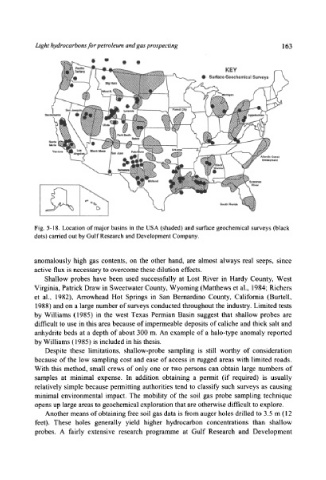
           Fig. 5-18. Location of major basins in the USA (shaded) and surface geochemical  surveys (black
           dots) carried out by Gulf Research and Development Company.


           anomalously  high  gas  contents,  on  the  other  hand,  are  almost  always  real  seeps,  since
           active  flux is necessary to overcome these dilution effects.
              Shallow  probes  have  been  used  successfully  at  Lost  River  in  Hardy  County,  West
           Virginia,  Patrick Draw in Sweetwater County,  Wyoming (Matthews et al.,  1984;  Richers
           et  al.,  1982),  Arrowhead  Hot  Springs  in  San  Bemardino  County,  Califomia  (Burtell,
           1988) and on a large number of surveys conducted  throughout  the  industry.  Limited tests
           by  Williams  (1985)  in  the  west  Texas  Permian  Basin  suggest  that  shallow  probes  are
           difficult to use in this area because  of impermeable  deposits  of caliche  and thick salt and
           anhydrite  beds  at a depth  of about  300  m.  An  example  of a  halo-type  anomaly  reported
           by Williams (1985)  is included  in his thesis.
              Despite  these  limitations,  shallow-probe  sampling  is  still  worthy  of  consideration
           because  of the  low  sampling  cost  and  ease  of access  in rugged  areas  with  limited  roads.
           With  this  method,  small  crews  of only  one  or  two  persons  can  obtain  large  numbers  of
           samples  at  minimal  expense.  In  addition  obtaining  a  permit  (if  required)  is  usually
           relatively simple  because  permitting  authorities  tend  to  classify  such  surveys  as  causing
           minimal  environmental  impact.  The  mobility  of the  soil  gas  probe  sampling  technique
           opens up large areas to geochemical exploration that are otherwise difficult to explore.
              Another means of obtaining free soil gas data  is from auger holes drilled to 3.5  m (12
           feet).  These  holes  generally  yield  higher  hydrocarbon  concentrations  than  shallow
           probes.  A  fairly  extensive  research  programme  at  Gulf  Research  and  Development

