


Page 183 - Geochemical Remote Sensing of The Sub-Surface
P. 183
160                                     V. T. Jones,  M.D.  Matthews and D.M.  Richers

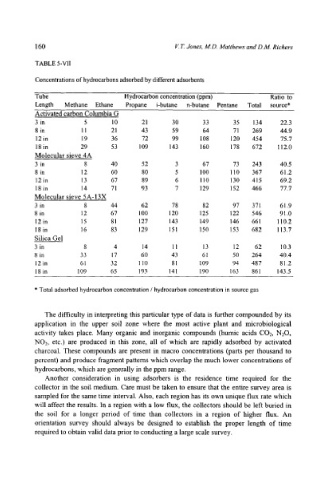
           TABLE 5-VII

           Concentrations of hydrocarbons adsorbed by different adsorbents
           Tube                     Hydrocarbon concentration (ppm)          Ratio  to
           Length   Methane   Ethane   Propane   i-butane   n-butane   Pentane   Total   source*
           Activated carbon Columbia G
           3 in          5       l 0     21       30      33       35    134    22.3
           8 in         11       21      43       59      64       71   269     44.9
           12 in        19       36      72       99      108     120   454     75.7
           18 in        29       53     109      143      160     178   672    112.0
           Molecular sieve 4A
           3 in          8       40      52        3      67       73   243     40.5
           8 in         12       60      80        5      100     110   367     61.2
           12 in        13       67      89        6      110     130   415     69.2
           18 in        14       71      93        7      129     152   466     77.7
           Molecular sieve 5A-13X
           3 in          8      44       62       78      82       97   371     61.9
           8 in         12      67      100      120      125     122   546     91.0
           12 in        15       81     127      143      149     146   661    110.2
           18 in        16       83     129      151      150     153   682    113.7
           Silica Gel
           3  in         8       4       14       11      13       12    62     10.3
           8 in         33       17      60       43      61       50   264     40.4
           12 in        61      32      110       81      109      94   487     81.2
           18 in       109      65      193      141      190     163   861    143.5

           * Total  adsorbed hydrocarbon concentration / hydrocarbon concentration in source gas


              The  difficulty  in interpreting  this particular  type  of data  is further compounded by  its
           application  in  the  upper  soil  zone  where  the  most  active  plant  and  microbiological
           activity  takes  place.  Many  organic  and  inorganic  compounds  (humic  acids  CO2,  N20,
           NO2,  etc.)  are  produced  in  this  zone,  all  of  which  are  rapidly  adsorbed  by  activated
           charcoal.  These  compounds  are  present  in  macro  concentrations  (parts  per  thousand  to
           percent)  and produce  fragment patterns  which  overlap  the much  lower  concentrations  of
           hydrocarbons,  which are generally in the ppm range.
              Another  consideration  in  using  adsorbers  is  the  residence  time  required  for  the
           collector  in  the  soil  medium.  Care  must  be  taken  to  ensure  that  the  entire  survey  area  is
           sampled for the  same time  interval.  Also,  each region has  its own unique  flux rate  which
           will  affect the  results.  In a region with  a  low  flux,  the  collectors  should be  left buried  in
           the  soil  for  a  longer  period  of  time  than  collectors  in  a  region  of  higher  flux.  An
           orientation  survey  should  always  be  designed  to  establish  the  proper  length  of  time
           required to obtain valid data prior to conducting  a large scale  survey.

