


Page 188 - Geochemical Remote Sensing of The Sub-Surface
P. 188
Light hydrocarbons for petroleum and gas prospecting                  165

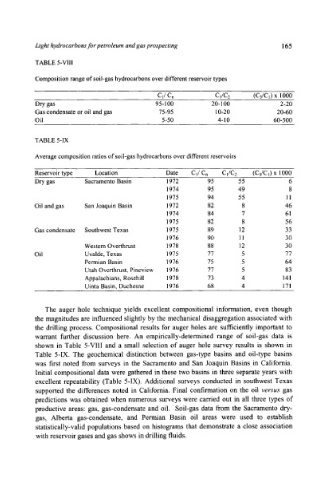
           TABLE 5-VIII

           Composition range of soil-gas hydrocarbons over different reservoir types

                                              CI/C  n         CI/C 2     (C3/C!) x  1000
           Dry gas                           95-100          20-100             2-20
           Gas condensate or oil and gas      75-95           10-20            20-60
           Oil                                 5-50            4-10           60-500

           TABLE 5-IX

           Average composition ratios of soil-gas hydrocarbons over different reservoirs

           Reservoir type   Location            Date   C1/C n   CI/C 2   (C3/CI) x  1000
           Dry gas       Sacramento Basin       1972        95      55             6
                                                1974        95      49             8
                                                1975        94      55            I 1
           Oil and gas   San Joaquin Basin      1972        82       8            46
                                                1974        84       7            61
                                                1975        82       8            56
           Gas condensate   Southwest Texas     1975        89       12           33
                                                1976        90       11           30
                         Western Overthrust     1978        88       12           30
           Oil           Uvalde, Texas          1975        77       5            77
                         Permian  Basin         1976        75       5            64
                         Utah Overthrust, Pineview   1976   77       5            83
                         Appalachians,  Rosehiil   ! 978    73       4           141
                         Uinta Basin,  Duchesne   1976      68       4           171


              The  auger  hole  technique  yields  excellent  compositional  information,  even  though
           the  magnitudes  are  influenced  slightly by the  mechanical  disaggregation  associated  with
           the  drilling  process.  Compositional  results  for  auger  holes  are  sufficiently  important  to
           warrant  further  discussion  here.  An  empirically-determined  range  of  soil-gas  data  is
           shown  in  Table  5-VIII  and  a  small  selection  of  auger  hole  survey  results  is  shown  in
           Table  5-IX.  The  geochemical  distinction  between  gas-type  basins  and  oil-type  basins
           was  first  noted  from  surveys  in  the  Sacramento  and  San  Joaquin  Basins  in  California.
           Initial  compositional  data  were  gathered  in these  two  basins  in three  separate  years  with
           excellent  repeatability  (Table  5-IX).  Additional  surveys  conducted  in  southwest  Texas
           supported  the  differences  noted  in  California.  Final  confirmation  on  the  oil  versus  gas
           predictions  was  obtained  when  numerous  surveys  were  carried  out  in  all  three  types  of
           productive  areas:  gas,  gas-condensate  and  oil.  Soil-gas  data  from  the  Sacramento  dry-
           gas,  Alberta  gas-condensate,  and  Permian  Basin  oil  areas  were  used  to  establish
           statistically-valid  populations  based  on  histograms  that  demonstrate  a  close  association
           with reservoir gases and gas shows in drilling fluids.

