


Page 193 - Geochemical Remote Sensing of The Sub-Surface
P. 193
170                                    V.T. Jones,  M.D. Matthews and D.M. Richers


                          ~T,~I   Md   ETI04
                      O0    9   ee    9       ~1'~    ~W
               !  wcJ,   e,~.,  u                         Delta
                                     e
                ~ewcme  g  ( wca~  ewmo  ~  .   .z,,      9
                                     9
                                1N
                                    Elm
                  9  ~  ~,                           Grand  I.
               worn  e4_          I   ,rt-._r--,__.r-"
                   ~       ~,.r-~--.rd.J"  I--  -   !  S  TImballer
               _  '--7  lYermillion   I  Eugenel.  I  "
             W.  uameron  I              --.
                              S.  Marsh   :~nnp
                 E.  Cameron             Shoal
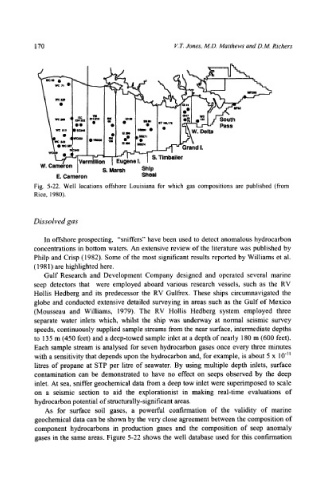
           Fig. 5-22. Well  locations  offshore Louisiana  for  which  gas  compositions  are  published  (from
           Rice, 1980).
           Dissolved  gas


              In offshore  prospecting,  "sniffers"  have been used  to detect  anomalous  hydrocarbon
           concentrations  in bottom  waters.  An extensive  review of the  literature  was  published  by
           Philp  and  Crisp  (1982).  Some  of the  most  significant  results  reported  by Williams  et  al.
           ( 1981) are highlighted here.
              Gulf  Research  and  Development  Company  designed  and  operated  several  marine
           seep  detectors  that  were  employed  aboard  various  research  vessels,  such  as  the  RV
           Hollis  Hedberg  and  its  predecessor  the  RV  Gulfrex.  These  ships  circumnavigated  the
           globe  and  conducted  extensive  detailed  surveying  in  areas  such  as  the  Gulf of Mexico
           (Mousseau  and  Williams,  1979).  The  RV  Hollis  Hedberg  system  employed  three
           separate  water  inlets  which,  whilst  the  ship  was  underway  at  normal  seismic  survey
           speeds,  continuously  supplied  sample  streams  from the near surface,  intermediate  depths
           to  135 m (450  feet) and a deep-towed  sample  inlet at a depth of nearly  180 m (600  feet).
           Each  sample  stream  is  analysed  for  seven  hydrocarbon  gases  once  every three  minutes
           with a sensitivity that depends  upon the hydrocarbon  and,  for example,  is about  5 x  10 1~
           litres  of propane  at  STP  per  litre  of  seawater.  By  using  multiple  depth  inlets,  surface
           contamination  can  be  demonstrated  to  have  no  effect  on  seeps  observed  by  the  deep
           inlet.  At sea,  sniffer geochemical  data  from a deep  tow inlet were  superimposed  to  scale
           on  a  seismic  section  to  aid  the  explorationist  in  making  real-time  evaluations  of
           hydrocarbon potential of structurally-significant areas.
              As  for  surface  soil  gases,  a  powerful  confirmation  of  the  validity  of  marine
           geochemical  data can be  shown by the very close agreement between the composition  of
           component  hydrocarbons  in  production  gases  and  the  composition  of  seep  anomaly
           gases  in the  same  areas.  Figure  5-22  shows  the  well  database  used  for this  confirmation

