


Page 189 - Geochemical Remote Sensing of The Sub-Surface
P. 189
166                                     V.T. Jones,  M.D.  Matthews and D.M.  Richers
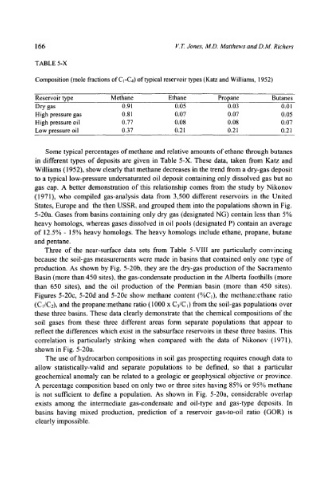
           TABLE 5-X

           Composition (mole fractions of C1-C4) of typical reservoir types (Katz and Williams, 1952)


           Reservoir type        Methane         Ethane        Propane        Butanes
           Dry gas                  0.91           0.05          0.03           0.01
           High pressure gas        0.81           0.07          0.07           0.05
           High pressure oil        0.77          0.08           0.08           0.07
           Low pressure oil         0.37          0.21           0.21           0.21


              Some typical percentages of methane and relative amounts of ethane through butanes
           in  different  types  of deposits  are  given  in  Table  5-X.  These  data,  taken  from  Katz  and
           Williams (1952), show clearly that methane decreases in the trend from a dry-gas deposit
           to a typical low-pressure undersaturated oil deposit containing only dissolved  gas but no
           gas  cap.  A  better  demonstration  of this  relationship  comes  from  the  study by Nikonov
           (1971),  who  compiled  gas-analysis  data  from  3,500  different  reservoirs  in  the  United
           States, Europe and  the then USSR,  and grouped them into the populations  shown in Fig.
           5-20a.  Gases from basins containing only dry gas (designated NG)  contain  less than  5%
           heavy homologs,  whereas gases dissolved  in oil pools (designated P) contain an average
           of  12.5%  -  15% heavy homologs.  The heavy homologs  include  ethane,  propane,  butane
           and pentane.
              Three  of  the  near-surface  data  sets  from  Table  5-VIII  are  particularly  convincing
           because  the  soil-gas  measurements were  made  in basins  that contained  only one  type of
           production.  As  shown by Fig.  5-20b,  they are the  dry-gas production  of the  Sacramento
           Basin (more than 450 sites), the gas-condensate production in the Alberta foothills (more
           than  650  sites),  and  the  oil  production  of  the  Permian  basin  (more  than  450  sites).
           Figures  5-20c,  5-20d  and  5-20e  show methane  content  (%C~), the  methane:ethane  ratio
           (C~/C2), and the propane:methane ratio (1000 x C3/C~) from the soil-gas populations over
           these  three basins.  These  data clearly demonstrate  that the chemical compositions  of the
           soil  gases  from  these  three  different  areas  form  separate  populations  that  appear  to
           reflect the differences  which exist in the subsurface reservoirs in these three basins.  This
           correlation  is  particularly  striking  when  compared  with  the  data  of  Nikonov  (1971),
           shown in Fig. 5-20a.
              The use of hydrocarbon compositions  in soil gas prospecting requires enough data to
           allow  statistically-valid  and  separate  populations  to  be  defined,  so  that  a  particular
           geochemical  anomaly can be related to  a geologic  or geophysical  objective  or province.
           A percentage composition based on only two or three  sites having 85% or 95%  methane
           is  not  sufficient  to  define  a  population.  As  shown  in  Fig.  5-20a,  considerable  overlap
           exists  among  the  intermediate  gas-condensate  and  oil-type  and  gas-type  deposits.  In
           basins  having  mixed  production,  prediction  of  a  reservoir  gas-to-oil  ratio  (GOR)  is
           clearly impossible.

