


Page 184 - Geochemical Remote Sensing of The Sub-Surface
P. 184
Light hydrocarbons for petroleum and gas prospecting                  161


                                                             Typical  Gas  Spectrum
              o
            rYo


                  ,;   '      2'   '      :1o   ,   ,;o   '   1~0   '   1~o   '   2~o   '   ~o   '
                                               M/Z


                                                              Typical 011 Spectrum


                                    ,
                                   ,
                               ,,ll .... Ih t,,,  ,I,  ....  ,,
                   i   !   -
                                                 140         ,~o   '   2~o   '   ~0
                                                M/Z
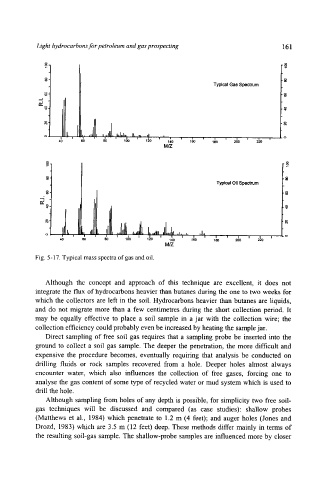
           Fig. 5-17. Typical mass spectra of gas and oil.


              Although  the  concept  and  approach  of  this  technique  are  excellent,  it  does  not
           integrate  the  flux  of hydrocarbons  heavier  than butanes  during  the  one  to two  weeks  for
           which  the  collectors  are  left  in  the  soil.  Hydrocarbons  heavier  than  butanes  are  liquids,
           and  do  not  migrate  more  than  a  few  centimetres  during  the  short  collection  period.  It
           may  be  equally  effective  to  place  a  soil  sample  in  a jar  with  the  collection  wire;  the
           collection efficiency could probably even be increased by heating the sample jar.
              Direct  sampling  of free  soil  gas  requires  that  a  sampling  probe  be  inserted  into  the
           ground  to  collect  a  soil  gas  sample.  The  deeper  the  penetration,  the  more  difficult  and
           expensive  the  procedure  becomes,  eventually  requiring  that  analysis  be  conducted  on
           drilling  fluids  or  rock  samples  recovered  from  a  hole.  Deeper  holes  almost  always
           encounter  water,  which  also  influences  the  collection  of  free  gases,  forcing  one  to
           analyse  the  gas  content  of some  type  of recycled water  or mud  system which  is used  to
           drill the hole.
              Although  sampling  from holes  of any depth  is possible,  for  simplicity  two  free  soil-
           gas  techniques  will  be  discussed  and  compared  (as  case  studies):  shallow  probes
           (Matthews  et  al.,  1984)  which  penetrate  to  1.2  m  (4  feet);  and  auger  holes  (Jones  and
           Drozd,  1983)  which  are  3.5  m  (12  feet)  deep.  These  methods  differ  mainly  in terms  of
           the  resulting  soil-gas  sample.  The  shallow-probe  samples  are  influenced  more by  closer

