


Page 180 - Geochemical Remote Sensing of The Sub-Surface
P. 180
Light hydrocarbons for petroleum and gas prospecting                  15 7


                4   -
             !
             0
             =   3


             <   2   -    I                     I
             7-
             W
                  0            IOO0          20OO
                                    Meters
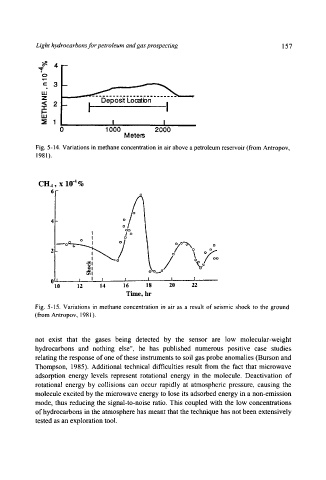
           Fig. 5-14. Variations in methane concentration in air above a petroleum reservoir (from Antropov,
           1981).


            CH4,  x  10"4%
               6-


               4-                   O
                                    O
                        ~  .....j   o  to
                           I
                           I
                 ~ 0  ~.~,,.~   I   0
                                             _o/
               2-          I

               0  i  ....   i..I...l   ,1   I    .1   .   f   ---
                10     12    14     16    18     20    22
                                     T~e,  hr

           Fig. 5-15. Variations  in methane concentration  in air as a result of seismic shock to the ground
           (from Antropov,  198 ! ).


           not  exist  that  the  gases  being  detected  by  the  sensor  are  low  molecular-weight
           hydrocarbons  and  nothing  else",  he  has  published  numerous  positive  case  studies
           relating the response of one of these instruments to soil gas probe  anomalies (Burson and
           Thompson,  1985).  Additional  technical  difficulties  result  from  the  fact  that  microwave
           adsorption  energy  levels  represent  rotational  energy  in  the  molecule.  Deactivation  of
           rotational  energy  by  collisions  can  occur  rapidly  at  atmospheric  pressure,  causing  the
           molecule excited by the microwave energy to lose  its adsorbed  energy in a non-emission
           mode,  thus  reducing  the  signal-to-noise  ratio.  This  coupled  with the  low concentrations
           of hydrocarbons  in the atmosphere has meant that the technique has not been extensively
           tested as an exploration tool.

