


Page 179 - Geochemical Remote Sensing of The Sub-Surface
P. 179
156                                    V.T. Jones,  M.D.  Matthews and D.M.  Richers


                  200  --                       Methane
                                                Hydrogen
                                                Propane
                                                   22--
                  ...-.
                  D.
                  z                            T  12oo
                  LU                                    O.
                                                  ~     W
                  a                            I   ~"   z
                  >-
                  -r          A   ~   I   ~    I   Z    "1-
                                                  ~

               SW                                        NE
             Feet  Metem
             SEA

           1000  ,.--


                 -                              9
             ooo-i_ o/,


                              ,-,,..,,, ER,.,,.,,
                  2100


            9O00
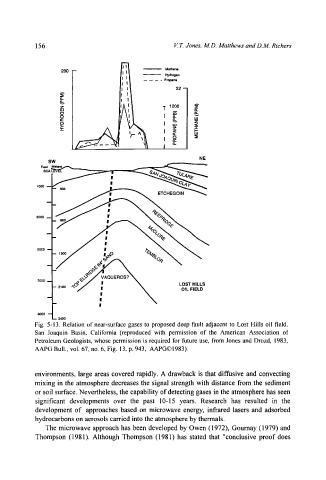
           Fig. 5-13. Relation of near-surface gases to  proposed deep fault adjacent  to  Lost Hills oil  field,
           San  Joaquin  Basin, California  (reproduced  with permission  of  the  American  Association  of
           Petroleum Geologists,  whose permission  is required for future use, from Jones and Drozd, 1983,
           AAPG Bull., vol. 67, no. 6, Fig. 13, p. 943,  AAPG 9


           environments,  large  areas  covered  rapidly.  A  drawback  is that  diffusive  and  convecting
           mixing  in the  atmosphere  decreases  the  signal  strength  with  distance  from  the  sediment
           or soil surface. Nevertheless, the capability of detecting gases  in the atmosphere  has seen
           significant  developments  over  the  past  10-15  years.  Research  has  resulted  in  the
           development  of  approaches  based  on  microwave  energy,  infrared  lasers  and  adsorbed
           hydrocarbons  on aerosols carried into the atmosphere by thermals.
              The microwave  approach  has  been  developed  by Owen  (1972),  Goumay  (1979)  and
           Thompson  (1981).  Although  Thompson  (198 l)  has  stated  that  "conclusive  proof  does

