


Page 181 - Geochemical Remote Sensing of The Sub-Surface
P. 181
158                                     V.T. Jones, M.D.  Matthews and D.M.  Richers

            CH4xl 0 -4 %

              3 f ....................                       .........
              0               ',            '!
             8L   6V   8V   10V   12V  I'~V   16V   18V   20V  22V  2,~V   26V   28V  Date
             m                                                        t
                          ,,  ,,h,                                 ,,I
                                   '    l"       '                    ,l'l

             -5o 1-                                                        t   "
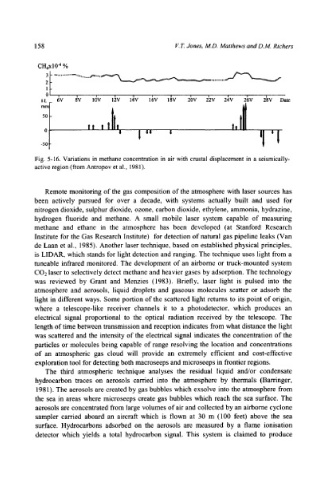
           Fig. 5-16. Variations  in methane concentration  in air with crustal  displacement  in a seismically-
           active region (from Antropov et al., 1981).


              Remote  monitoring  of the  gas composition  of the  atmosphere  with  laser  sources  has
           been  actively  pursued  for  over  a  decade,  with  systems  actually  built  and  used  for
           nitrogen dioxide,  sulphur dioxide,  ozone,  carbon  dioxide,  ethylene,  ammonia,  hydrazine,
           hydrogen  fluoride  and  methane.  A  small  mobile  laser  system  capable  of  measuring
           methane  and  ethane  in  the  atmosphere  has  been  developed  (at  Stanford  Research
           Institute  for the  Gas  Research  Institute)  for detection  of natural  gas pipeline  leaks  (Van
           de  Laan et al.,  1985).  Another  laser technique,  based  on  established  physical  principles,
           is LIDAR,  which  stands  for light detection  and  ranging.  The  technique  uses  light  from  a
           tuneable  infrared  monitored.  The  development  of an  airborne  or  truck-mounted  system
           CO2 laser to selectively detect methane  and  heavier gases by adsorption.  The  technology
           was  reviewed  by  Grant  and  Menzies  (1983).  Briefly,  laser  light  is  pulsed  into  the
           atmosphere  and  aerosols,  liquid  droplets  and  gaseous  molecules  scatter  or  adsorb  the
           light  in different  ways.  Some  portion  of the  scattered  light  returns  to  its point  of origin,
           where  a  telescope-like  receiver  channels  it  to  a  photodetector,  which  produces  an
           electrical  signal  proportional  to  the  optical  radiation  received  by  the  telescope.  The
           length of time between transmission  and reception  indicates  from what distance  the  light
           was  scattered  and  the  intensity of the  electrical  signal  indicates  the  concentration  of the
           particles  or  molecules  being  capable  of range  resolving  the  location  and  concentrations
           of  an  atmospheric  gas  cloud  will  provide  an  extremely  efficient  and  cost-effective
           exploration tool for detecting both macroseeps and microseeps  in frontier regions.
              The  third  atmospheric  technique  analyses  the  residual  liquid  and/or  condensate
           hydrocarbon  traces  on  aerosols  carried  into  the  atmosphere  by  thermals  (Barringer,
           1981).  The  aerosols  are  created by gas bubbles  which  exsolve  into  the  atmosphere  from
           the  sea  in  areas  where  microseeps  create  gas  bubbles  which  reach  the  sea  surface.  The
           aerosols are concentrated  from large volumes of air and collected by an airborne  cyclone
           sampler  carried  aboard  an  aircraft  which  is  flown  at  30  m  (100  feet)  above  the  sea
           surface.  Hydrocarbons  adsorbed  on  the  aerosols  are  measured  by  a  flame  ionisation
           detector  which  yields  a  total  hydrocarbon  signal.  This  system  is  claimed  to  produce

