


Page 178 - Geochemical Remote Sensing of The Sub-Surface
P. 178
Light hydrocarbons for petroleum and gas prospecting                  155


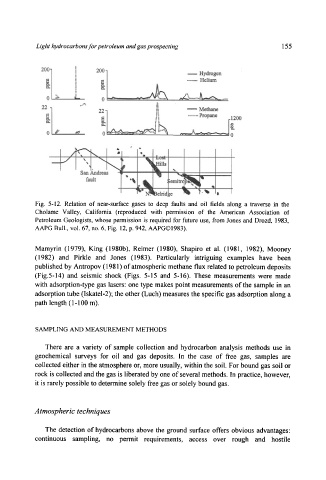
           Fig. 5-12. Relation  of near-surface  gases  to  deep faults and  oil  fields along  a  traverse  in  the
           Cholame  Valley,  California  (reproduced  with  permission  of  the  American  Association  of
           Petroleum Geologists,  whose permission  is required for future use, from Jones and Drozd,  1983,
           AAPG Bull., vol. 67, no. 6, Fig. 12, p. 942, AAPG 9

           Mamyrin  (1979),  King  (1980b),  Reimer  (1980),  Shapiro  et  al.  (1981,  1982),  Mooney
           (1982)  and  Pirkle  and  Jones  (1983).  Particularly  intriguing  examples  have  been
           published  by Antropov (1981) of atmospheric  methane  flux related to petroleum  deposits
           (Fig.5-14)  and  seismic  shock  (Figs.  5-15  and  5-16).  These  measurements  were  made
           with  adsorption-type  gas  lasers:  one type makes point  measurements  of the  sample  in an
           adsorption tube (Iskatel-2); the other (Luch) measures the specific  gas adsorption  along a
           path  length (1-100 m).


           SAMPLING AND MEASUREMENT METHODS


              There  are  a  variety  of  sample  collection  and  hydrocarbon  analysis  methods  use  in
           geochemical  surveys  for  oil  and  gas  deposits.  In  the  case  of  free  gas,  samples  are
           collected either in the atmosphere  or, more usually, within the soil. For bound  gas soil or
           rock is collected and the gas is liberated by one of several methods.  In practice,  however,
           it is rarely possible to determine  solely free gas or solely bound  gas.


           Atmospheric  techniques

              The  detection  of hydrocarbons  above  the  ground  surface  offers  obvious  advantages:
           continuous  sampling,  no  permit  requirements,  access  over  rough  and  hostile

