


Page 198 - Geochemical Remote Sensing of The Sub-Surface
P. 198
Light hydrocarbons for petroleum and gas prospecting                  175


           ml  aliquot of the  headspace  is sampled  using  a locking  gas-tight syringe.  The  sample  is
           then  hand  injected  into  a  gas  chromatograph  equipped  with  a  flame  ionisation  detector
           for analysis of the disaggregated gases.  It is assumed that these gases represent micopore
           gas, some free gas and lightly adsorbed gas on the sample-medium surface.
              This technique  (or modifications  of it) has been used  in the  analysis  of well  cuttings
           and  deep  sea  cores  (Hunt  and  Whelan,  1979),  in  addition  to  surface  geochemical
           prospecting (Richers et al.,  1986; Richers and Weatherby,  1985).
              Initial  tests  of  this  method  were  conducted  at  Gulf  Research  and  Development
           Company  for  comparison  with  the  auger  hole  technique  and  to  gain  a  better
           understanding  of the  relationship  between  free  gas  and  adsorbed  gases  liberated  by  the
           drilling  process.  To  be  an  effective  and viable  technique,  the  disaggregation  desorption
           method  must be  able  to distinguish between  oily and  gassy areas.  An  area  known to be
           predominantly  oily,  Rose  Hill  in  Lee  County,  Virginia,  and  another  known  to  be
           predominantly  gassy,  the  Gulf  Research  Facility  in  Pittsburgh,  Pennsylvania,  were
           chosen as  initial test sites.  Both areas  had been  sampled previously using the  auger hole
           technique,  allowing the new data to be compared with the established  data  sets (Richers,
           1984).
              The  Rose  Hill  test  site  includes  126  soil cores  of which  51  fall  within  300  m  (1,000
           feet)  of the  earlier  auger holes.  Despite  differences  in  the  sample  locations  and  depths,
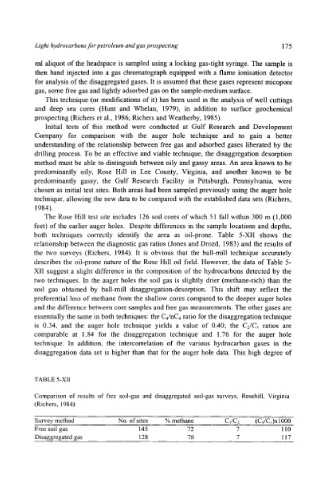
           both  techniques  correctly  identify  the  area  as  oil-prone.  Table  5-XII  shows  the
           relationship between  the diagnostic gas ratios (Jones and Drozd,  1983) and the results of
           the  two  surveys  (Richers,  1984).  It  is  obvious  that  the  ball-mill  technique  accurately
           describes  the  oil-prone  nature  of the  Rose  Hill  oil  field.  However,  the  data  of Table  5-
           XII  suggest  a  slight  difference  in  the  composition  of the  hydrocarbons  detected  by  the
           two  techniques.  In  the  auger holes  the  soil  gas  is  slightly  drier  (methane-rich)  than  the
           soil  gas  obtained  by  ball-mill  disaggregation-desorption.  This  shift  may  reflect  the
           preferential  loss of methane  from the  shallow  cores  compared to the  deeper  auger holes
           and the difference between core samples and free gas measurements.  The other gases are
           essentially the same  in both techniques:  the C4/nC4 ratio for the disaggregation technique
           is  0.34,  and  the  auger  hole  technique  yields  a  value  of  0.40;  the  C2/C 3  ratios  are
           comparable  at  1.84  for  the  disaggregation  technique  and  1.76  for  the  auger  hole
           technique.  In  addition,  the  intercorrelation  of  the  various  hydrocarbon  gases  in  the
           disaggregation  data  set  is  higher  than  that  for  the  auger  hole  data.  This  high  degree  of


           TABLE 5-XII

           Comparison  of  results of  free soil-gas and  disaggregated  soil-gas surveys, Rosehill, Virginia
           (Richers,  1984)


           Survey method           No. of sites   % methane      CI/C 2   (C3/Ci)x 1000
           Free soil gas                145           72            7            110
           Disaggregated gas            128           70            7            117

