


Page 197 - Geochemical Remote Sensing of The Sub-Surface
P. 197
174                                     V.T. Jones,  M.D.  Matthews and D.M.  Richers

                '--     ?.5cm     L,


                                         LICONE  RUBBER  SEAL
                                         5cm  OUTSIDE  DIA.
                                         5cm  INSIDE  DIA.


             6.                          f   INJECTION  PORT


                                      /--  THREADED P I PE  I crn  D ~ A.
                                     /   ~  SEPTUM CAP  FROM VARI AN
                                     /   J   S I L I CONE RUBBER
                                    /   ~   /SEPTUM,  ,crn DIA.
                                I~   r   "i'-i~,NJECT,ON  PO~T
                                  llllilllllilllll i,  -  -
                                   2cm   ~   -'   '--   -


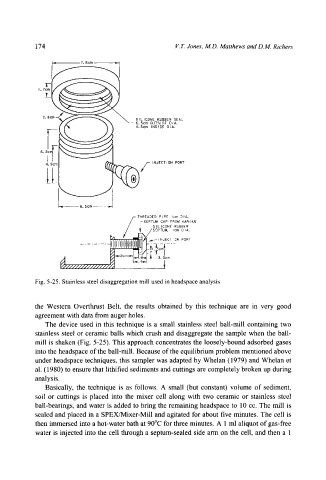
           Fig. 5-25. Stainless steel disaggregation mill used in headspace analysis


           the  Western  Overthrust  Belt,  the  results  obtained  by  this  technique  are  in  very  good
           agreement with data from auger holes.
              The  device  used  in  this  technique  is  a  small  stainless  steel  ball-mill  containing  two
           stainless  steel  or ceramic  balls  which  crush  and  disaggregate  the  sample  when  the  ball-
           mill  is shaken (Fig.  5-25).  This approach concentrates  the  loosely-bound adsorbed  gases
           into the headspace of the ball-mill.  Because of the equilibrium problem mentioned above
           under headspace  techniques,  this sampler was adapted by Whelan  (1979)  and Whelan  et
           al. (1980) to ensure that lithified sediments and cuttings are completely broken up during
           analysis.
              Basically,  the  technique  is  as  follows.  A  small  (but  constant)  volume  of  sediment,
           soil  or  cuttings  is  placed  into  the  mixer  cell  along  with  two  ceramic  or  stainless  steel
           ball-bearings,  and water is added to bring the  remaining headspace  to  10 cc.  The  mill  is
           sealed  and placed  in a SPEX/Mixer-Mill  and agitated  for about five minutes.  The  cell  is
           then immersed into a hot-water bath at 90~  for three minutes.  A  1 ml aliquot of gas-free
           water is injected  into the cell through a septum-sealed  side  arm on the  cell,  and then a  1

