


Page 201 - Geochemical Remote Sensing of The Sub-Surface
P. 201
178                                     K T. Jones, M.D.  Matthews and D.M.  Richers


                         10~ < SAND  ~,01t                          4(MM~ CARB  ~;0%


                                         i:+:i:+:'. "-,'-''+''''+'"-
             l                          ~ o . o   o % ~,,,
                    3~ Content   ~                                Gas Content   >
                                                                            Ca~RB -  O~


              T    "~    CAM -  I~                             "

              i                                                       Gas Content
                                                                       -  O~
                    Gas Content                           i   9 .  ~ [   D  C.,ARB -  0%
                                    I T   I  I  501,1( SAND '~"0~
                                                <.<,
                                         o.<c....
                                    I'
                                                          u.
                                         m 3              I
                                    I                           Gas ~tent---'--~
                                       + +-  Gas Q~tent   >
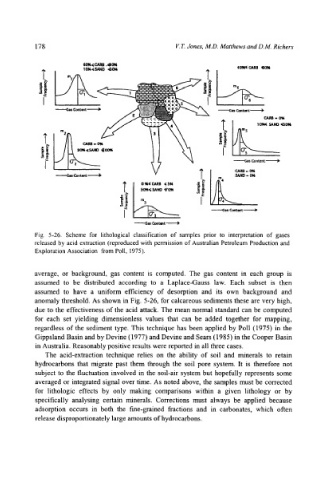
           Fig.  5-26. Scheme for  lithological classification of  samples prior  to  interpretation of  gases
           released by acid extraction (reproduced with permission of Australian Petroleum Production and
           Exploration Association from Poll, 1975).


           average,  or  background,  gas  content  is  computed.  The  gas  content  in  each  group  is
           assumed  to  be  distributed  according  to  a  Laplace-Gauss  law.  Each  subset  is  then
           assumed  to  have  a  uniform  efficiency  of  desorption  and  its  own  background  and
           anomaly threshold.  As shown in Fig.  5-26,  for calcareous  sediments these  are very high,
           due  to  the  effectiveness  of the  acid  attack.  The  mean  normal  standard  can be  computed
           for  each  set  yielding  dimensionless  values  that  can  be  added  together  for  mapping,
           regardless  of the  sediment  type.  This  technique  has  been  applied  by  Poll  (1975)  in  the
           Gippsland Basin and by Devine (1977) and Devine and Sears (1985) in the Cooper Basin
           in Australia.  Reasonably positive results were reported in all three cases.
              The  acid-extraction  technique  relies  on  the  ability  of  soil  and  minerals  to  retain
           hydrocarbons  that  migrate  past  them  through  the  soil  pore  system.  It  is  therefore  not
           subject  to  the  fluctuation  involved  in the  soil-air  system but  hopefully  represents  some
           averaged  or  integrated  signal over time.  As  noted  above,  the  samples  must be  corrected
           for  lithologic  efti~cts by  only  making  comparisons  within  a  given  lithology  or  by
           specifically  analysing  certain  minerals.  Corrections  must  always  be  applied  because
           adsorption  occurs  in  both  the  fine-grained  fractions  and  in  carbonates,  which  often
           release disproportionately large amounts of hydrocarbons.

