


Page 255 - Geochemistry of Oil Field Waters
P. 255
RESEARCH STUDIES                                                     23 9

              1,000
              000
              600                               Louisiana
                                                Mississippi
              400                               Alabama
                                                Arkansas
                                                Texas
            -  2 00
            \
            0
                                                  000 4, 0
               100                                         0  0
            : 00
            2   60                      0
            0
                40                    0
                                           0
                20

                                                                00

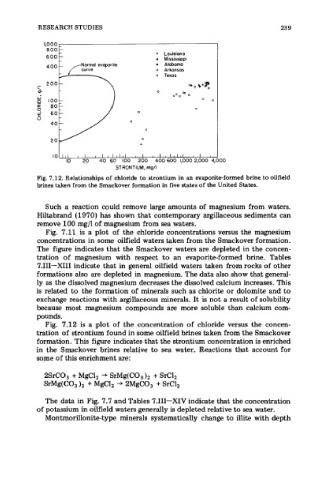
            Fig. 7.12. Relationships  of chloride to strontium in  an evaporite-formed brine to oilfield
            brines taken from the Smackover formation in five states of the United States.


              Such  a  reaction  could remove  large amounts of  magnesium from waters.
            Hiltabrand  (1970) has shown that contemporary argillaceous sediments can
            remove 100 mg/l of magnesium from sea waters.
              Fig.  7.11  is a  plot  of  the chloride concentrations versus the magnesium
            concentrations  in some  oilfield waters taken from the Smackover formation.
            The  figure indicates that the Smackover waters are depleted in the concen-
            tration  of  magnesium  with  respect  to  an  evaporite-formed  brine.  Tables
            7.111-XI11  indicate that in general oilfield waters taken  from rocks of other
            formations also are depleted  in  magnesium. The data also show that general-
            ly as the dissolved magnesium decreases the dissolved calcium increases. This
            is related  to the formation  of  minerals such as chlorite or dolomite and to
            exchange reactions  with argillaceous minerals. It is not a result of solubility
            because  most  magnesium  compounds  are  more  soluble  than  calcium com-
            pounds.
              Fig.  7.12  is a  plot  of  the concentration  of  chloride  versus the  concen-
            tration  of  strontium found in some oilfield brines taken from the Smackover
            formation. This figure indicates that the strontium concentration is enriched
            in  the  Smackover  brines  relative  to sea  water.  Reactions  that  account for
            some of this enrichment are:

              2SrC03 + MgCl,  +. SrMg(C03), + SrCl,
              SrMg(C0, ),  + MgCl,  +. 2MgC0,  + SrC1,

              The data in Fig. 7.7 and Tables 7.111-XIV  indicate that the concentration
            of potassium in oilfield waters generally is depleted relative to sea water.
              Montmorillonite-type minerals  systematically  change to illite with depth

