


Page 254 - Geochemistry of Oil Field Waters
P. 254
23 8                                        ORIGIN OF OILFIELD WATERS


            many  samples  were  used  in  the calculation.  For  example,  71 Smackover
            brines were analyzed for lithium, while 283 were analyzed for sodium.
              The concentration  ratios  (Table  7.XVIII)  indicate  that  all  of  the deter-
            mined  constituents  in  the  Smackover  brines were enriched with  respect  to
            sea  water  except  sulfate.  However,  the  excess  factor ratios  indicate  that
           sodium,  potassium,  magnesium,  chloride,  sulfate, and total equivalent  mag-
           nesium  were depleted in the Smackover brines, while lithium, calcium, stron-
           tium,  barium,  copper,  iron, manganese,  and iodide were  enriched.  Further,
           these  ratios  indicate  that the Smackover brines have  been  altered  consider-
           ably if  it is assumed that they originally were sea water.
              The  concentration  ratio  48 for  bromide  (Table  7.XVIII)  is  one  of  the
           highest that this author has seen. For example, bromide concentration ratios
           of 1.2 (Table 7.XIX), 4.4 (Table 7.XX), and 8.8 and 7.2 were found for brines
           from  Tertiary,  Cretaceous,  Pennsylvanian,  and  Mississippian  age  rocks
           (Collins, 1967, 1969a, 1970). The concentration ratios and excess factors in
           Tables  7.XIX  and XX  indicate several constituents are enriched and several
           are depleted in these brines also.
              Almost  one-third of  the magnesium  in  sea water  and subsequent bitterns
           can  be  removed  during  the  dolomitization  reaction.  The  formation  of
           chlorite from montmorillonite  requires about 9.2 moles of  MgO per mole of
           chlorite (Eckhardt, 1958):

              1.7 A1203  0.9 MgO  8 Si02 -  2 H20 + 9.2 MgO + 6 H20 +=
                                 10.1 MgO  1.7 A1203  6.4 Si02 *  8 H20 + 1.6 Si02


             1,000  -
             800  -
             600  -                            a  Louisiana
                                                  Mississippi
             400 -                             A  Alabama
                                               0  Arkansas
           \ - 200  -     o  a        */       0   Texas
            cn
           W*
           g  100:
           5  80-                               ‘Normal  evaporite
           I  60  -                               curve
           0
               40  -
                     0
              20  -
               10  III   I   I   I   I   I  I  1161   I   I   I   I   I  I  1 1 8 1  I  I   I
                                                               00


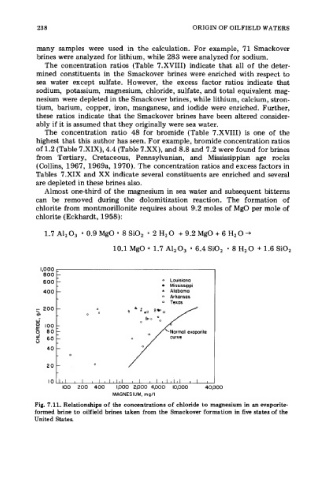
           Fig. 7.11. Relationships of the concentrations of chloride to magnesium in an evaporite-
           formed brine to oilfield brines taken from the  Smackover formation  in five states of the
           United States.

