


Page 251 - Geochemistry of Oil Field Waters
P. 251
RESEARCH  STUDIES                                                    23 5


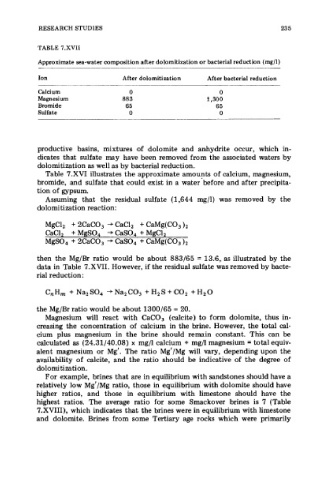
            TABLE 7.XVII
            Approximate sea-water composition after dolomitization or bacterial reduction (mg/l)

            Ion                     After dolomitization    After bacterial reduction

            Calcium                   0                         0
            Magnesium               883                     1,300
            Bromide                  65                        65
            Sulfate                   0                         0


            productive  basins,  mixtures  of  dolomite  and  anhydrite  occur,  which  in-
            dicates  that  sulfate  may  have been removed  from the associated  waters by
            dolomitization as well as by bacterial reduction.
              Table  7.XVI illustrates the approximate amounts of calcium, magnesium,
            bromide,  and  sulfate that could exist in a water’before and after precipita-
            tion of gypsum.
              Assuming  that  the  residual  sulfate  (1,644  mg/l)  was  removed  by  the
            dolomitization reaction:

              MgC12  + 2CaC0,  += CaC12  + CaMg(C0, )*
                                                    --
              CaC12-  + MgS04- += CaS04 + MgCi2
              MgSO,  + 2CaC03 + CaS04 + CaMg(C0, )2
            then  the Mg/Br  ratio  would  be  about  883/65 = 13.6, as illustrated  by the
            data in Table  7.XVII. However, if  the residual sulfate was removed by bacte-
            rial reduction :

              C,H,   + Na2 SO4  + Na2C03 + H2S + C02 + H20

            the Mg/Br ratio would be about 1300/65 = 20.
              Magnesium  will  react  with  CaC03  (calcite) to form  dolomite,  thus  in-
            creasing the  concentration  of  calcium  in the brine. However, the total cal-
            cium  plus  magnesium  in  the  brine  should  remain  constant.  This  can  be
            calculated as (24.31/40.08) x  mg/l calcium + mg/l magnesium = total equiv-
            alent  magnesium  or  Mg’.  The  ratio  Mg’/Mg will  vary,  depending upon the
            availability  of  calcite,  and the ratio  should  be  indicative  of  the degree  of
            dolomitization.
              For  example, brines that are in equilibrium with sandstones should have a
            relatively  low Mg’/Mg ratio, those in equilibrium with dolomite should have
            higher  ratios,  and  those  in  equilibrium  with  limestone  should  have  the
            highest  ratios.  The  average  ratio  for  some  Smackover  brines  is  7  (Table
            7.XVIII), which indicates that the brines were in equilibrium with limestone
            and  dolomite.  Brines  from  some  Tertiary  age  rocks  which  were  primarily

