


Page 252 - Geochemistry of Oil Field Waters
P. 252
236                                         ORIGIN OF OILFIELD WATERS


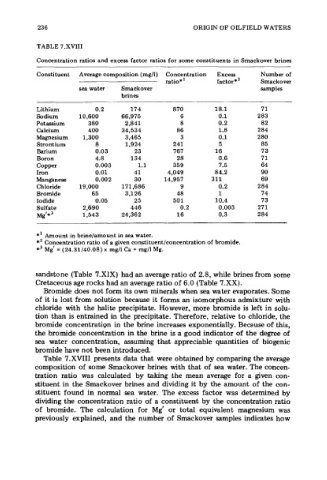
            TABLE 7.XVIII
            Concentration ratios and excess factor ratios for some constituents in Smackover brines

            Constituent   Average composition (mg/l)  Concentration   Excess   Number of
                                                ratio*'        factor*'    Smackover
                        sea water   Smackover                              samples
                                    brines

            Lithium         0.2       17 4        870         18.1          71
            Sodium      10,600      66,975           6         0.1        283
            Potassium     380        2,841           8         0.2          82
            Calcium       400       34,534          86         1.8         284
            Magnesium    1,300       3,465           3         0.1        280
            Strontium       8        1,924         241          5           85
            Barium          0.03        23         767        16            73
            Boron           4.8       134           28         0.6          71
            Copper          0.003        1.1      359           7.5         64
            Iron            0.01       41        4,049        84.2          90
            Manganese       0.002      30       14,957       31 1           69
            Chloride    19,000      171,686          9         0.2         284
            Bromide        65        3,126          48          1           74
            Iodide          0.05       25          501        10.4          73
            Sulfate      2,690        446            0.2       0.003       27 1
            Mg'*         1,543      24,362          16         0.3        284

            *' Amount in brine/amount in sea water.
            ** Concentration ratio of a given constituent/concentration of bromide.
            *3  Mg' = (24.31/40.08) x  mg/l Ca  + mg/l Mg.


           sandstone (Table 7.XIX) had an average ratio of  2.8, while brines from some
           Cretaceous age rocks had an average ratio of 6.0 (Table 7.XX).
              Bromide does not form its own minerals when sea water evaporates. Some
           of  it is lost from solution  because it forms an isomorphous admixture with
           chloride  with  the halite precipitate.  However, more bromide is left in solu-
           tion than is entrained in the precipitate.  Therefore, relative to chloride, the
           bromide concentration  in the brine  increases exponentially. Bemuse of  this,
           the bromide concentration in the brine is a good indicator of  the degree of
           sea  water  concentration,  assuming that  appreciable  quantities  of  biogenic
           bromide have not been introduced.
              Table 7.XVIII  presents  data that were obtained by comparing the average
           composition of  some Smackover brines with that of  sea water. The concen-
           tration  ratio  was  calculated  by  taking  the mean  average for a  given  con-
           stituent in the Smackover brines and dividing it by  the amount of  the con-
           stituent  found  in  normal  sea  water.  The excess  factor  was  determined by
           dividing the concentration  ratio of  a constituent  by the concentration ratio
           of  bromide.  The  calculation  for  Mg'  or  total  equivalent  magnesium  was
           previously  explained,  and the number  of  Smackover samples indicates how

