


Page 276 - Geology and Geochemistry of Oil and Gas
P. 276
MODELS OF STATIC GEOLOGIC SYSTEMS                                    239
             from generally used forms (ppm or mg/l, ppk or g/l) expresses ion combination in
             equivalent quantities, depending on their ionic mass and valence. This conversion is
             performed by dividing the amount of ion by the equivalent mass of the ion. The sum
             of the cations in mg-eq. must be equal to the sum of anions in mg-eq. The sums of the
             anions and cations are equated 50% each and their total sum is equal 100%. Palmer
             proposed to determine the following six characteristics of the subsurface waters:
                                         +
             (1) First salinity S 1 includes Na +K +  salts of strong acids.
             (2) Second salinity S 2 includes Ca 2+ +Mg 2+  salts of strong acids.
             (3) Third salinity S 3 includes Fe salts of strong acids.
                                            +
             (4) First alkalinity A 1 includes Na +K +  salts of weak acids.
             (5) Second alkalinity A 2 includes Ca 2+ +Mg 2+  salts of weak acids.
             (6) Third alkalinity A 3 includes salts of Fe and H +  in combination with weak acids.
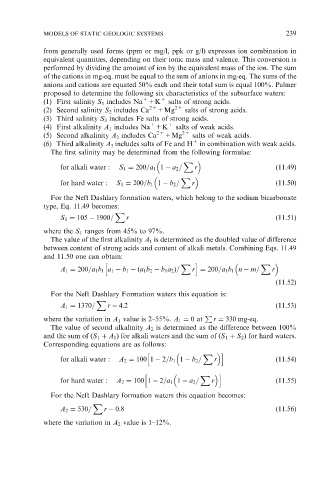
               The first salinity may be determined from the following formulae:

                                                     X
                  for alkali water :  S 1 ¼ 200=a 1 1   a 2 =  r               (11.49)
                                                    X

                  for hard water :  S 1 ¼ 200=b 1 1   b 2 =  r                 (11.50)
               For the Neft Dashlary formation waters, which belong to the sodium bicarbonate
             type, Eq. 11.49 becomes:
                                  X
                  S 1 ¼ 105   1900=  r                                         (11.51)
             where the S 1 ranges from 45% to 97%.
               The value of the first alkalinity A 1 is determined as the doubled value of difference
             between content of strong acids and content of alkali metals. Combining Eqs. 11.49
             and 11.50 one can obtain:
                               h
                                                    X i                    X
                  A 1 ¼ 200=a 1 b 1 a 1   b 1   ða 1 b 2   b 1 a 2 Þ=  r ¼ 200=a 1 b 1 n   m=  r
                                                                               (11.52)
               For the Neft Dashlary Formation waters this equation is:
                            X
                  A 1 ¼ 1370=   r   4:2                                        (11.53)
                                                           P
             where the variation in A 1 value is 2–55%. A 1 ¼ 0 at  r ¼ 330 mg-eq.
               The value of second alkalinity A 2 is determined as the difference between 100%
             and the sum of ðS 1 þ A 1 Þ for alkali waters and the sum of ðS 1 þ S 2 Þ for hard waters.
             Corresponding equations are as follows:

                                           h               X  i
                  for alkali water :  A 2 ¼ 100 1   2=b 1 1   b 2 =  r         (11.54)
                                          h
                                                          X  i
                  for hard water :  A 2 ¼ 100 1   2=a 1 1   a 2 =  r           (11.55)
               For the Neft Dashlary formation waters this equation becomes:
                           X
                  A 2 ¼ 530=   r   0:8                                         (11.56)
             where the variation in A 2 value is 1–12%.

