


Page 598 - Handbook of Battery Materials
P. 598
572  17 Liquid Nonaqueous Electrolytes

                      However, fluoride is not the only reason for passivation. LiBOB (see also
                    Figure 17.8a) passivates the Al surface although it contains no fluoride, whereas
                    LiTFSI and LiOTf (Figure 17.9) lead to severe Al corrosion and dissolution. In
                    the case of LiBOB, a passivating layer of AlBO 3 is formed protecting Al even in
                    presence of highly corrosive salts [100]. Measurements with pretreated Al surfaces,
                    which were previously passivated by electrolytes containing LiBOB, show negligible
                    corrosion and a stable passive layer even with highly corrosive salts. Aluminum
                    surfaces, pretreated with LiPF 6 , cannot resist these dissolution processes [261].
                      Figure 17.9 shows the reaction of LiOTf, a highly corrosive salt, with an Al-foil
                                              +
                    WE. At 4.1 V and above vs Li/Li , current density increases slightly at first, then
                    more strongly due to electrolyte decomposition and dissolution events. The re-scan
                    shows further increase of current,which, in contrast to the current behavior in
                    Figure 17.8a, reveals not passivation but corrosion. Only at potentials below 2.9 V
                    vs Li/Li does the current drop to zero. Subsequent scans display an increase in
                          +
                    current density and further corrosion of aluminum at much lower potentials, from
                    3.3 V vs Li/Li and above, resulting in small pits across the surface.
                               +
                      The reason for the corrosivity of lithium salts like LiOTf, LiTFSI, or LiMe in
                    organic solvents is the anion. The reduction products of the trifluoromethylsulfonyl
                    anions undergo reactions with aluminum on the surface, the reaction products
                    desorb from the surface, and the characteristic pit corrosion develops [293]. Naka-
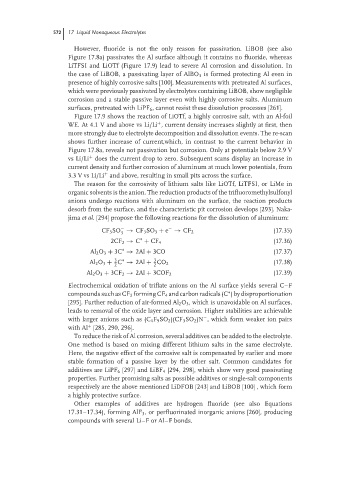
                    jima et al. [294] propose the following reactions for the dissolution of aluminum:
                                   −             −
                              CF 3 SO → CF 3 SO 3 + e → CF 2                  (17.35)
                                   3
                                         ∗
                                2CF 2 → C + CF 4                              (17.36)
                                    ∗
                           Al 2 O 3 + 3C → 2Al + 3CO                          (17.37)
                                 3  ∗        3
                          Al 2 O 3 + C → 2Al + CO 2                           (17.38)
                                 2           2
                                                                              (17.39)
                          Al 2 O 3 + 3CF 2 → 2Al + 3COF 2
                    Electrochemical oxidation of triflate anions on the Al surface yields several C–F
                    compounds suchas CF 2 forming CF 4 and carbonradicals (C )bydisproportionation
                                                                  ∗
                    [295]. Further reduction of air-formed Al 2 O 3 , which is unavoidable on Al surfaces,
                    leads to removal of the oxide layer and corrosion. Higher stabilities are achievable
                                                           −
                    with larger anions such as (C 4 F 9 SO 2 )(CF 3 SO 2 )N , which form weaker ion pairs
                    with Al [285, 290, 296].
                          +
                      To reduce the risk of Al corrosion, several additives can be added to the electrolyte.
                    One method is based on mixing different lithium salts in the same electrolyte.
                    Here, the negative effect of the corrosive salt is compensated by earlier and more
                    stable formation of a passive layer by the other salt. Common candidates for
                    additives are LiPF 6 [297] and LiBF 4 [294, 298], which show very good passivating
                    properties. Further promising salts as possible additives or single-salt components
                    respectively are the above mentioned LiDFOB [243] and LiBOB [100] , which form
                    a highly protective surface.
                      Other examples of additives are hydrogen fluoride (see also Equations
                    17.31–17.34), forming AlF 3 , or perfluorinated inorganic anions [260], producing
                    compounds with several Li–F or Al–F bonds.

