


Page 499 - Handbook of Electrical Engineering
P. 499
GENERALISED THEORY OF ELECTRICAL MACHINES      489


                                        X 2
              Armature time constant T a
                                       ωR a
                                                             1
              Q-axis sub-transient open-circuit time constant T      =  (X kq + X mq )
                                                       qo
                                                           ωR kq
                                                             1           X mq X a

              Q-axis sub-transient short-circuit time constant T =  X kq +
                                                       q
                                                           ωR kq       X mq + X a
                                                     1
              Q-axis damper leakage time constant T kq =  X kq
                                                   ωR kq
              Negative phase sequence reactance


                                       	             X + X     q    2X X    q
                                                                      d
                                                       d

                                  X 2 =  X · X q     or        or
                                          d

                                                        2          X + X
                                                                     d    q

                   Zero phase sequence reactance X o has a value lower than X and is a complex function of
                                                                     d
              the slot pitching of the stator windings and the leakage reactance present in their end windings,
              see Reference 7, Chapter XII.
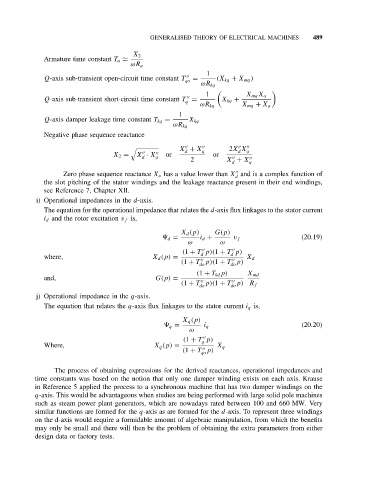
            i) Operational impedances in the d-axis.
              The equation for the operational impedance that relates the d-axis flux linkages to the stator current
              i d and the rotor excitation v f is,
                                                      X d (p)   G(p)
                                                  d =      i d +     v f                 (20.19)
                                                        ω        ω


                                                      (1 + T p)(1 + T p)
                                                                    d
                                                           d
              where,                         X d (p) =                   X d


                                                      (1 + T p)(1 + T p)
                                                           do       do
                                                          (1 + T kd p)   X md
              and,                            G(p) =

                                                      (1 + T p)(1 + T p) R f
                                                           do       do
            j) Operational impedance in the q-axis.
              The equation that relates the q-axis flux linkages to the stator current i q is,
                                                      X q (p)
                                                   q =      i q                          (20.20)
                                                        ω

                                                      (1 + T p)
                                                            q
              Where,                          X q (p) =         X q
                                                      (1 + T p)

                                                            qo
                 The process of obtaining expressions for the derived reactances, operational impedances and
           time constants was based on the notion that only one damper winding exists on each axis. Krause
           in Reference 5 applied the process to a synchronous machine that has two damper windings on the
           q-axis. This would be advantageous when studies are being performed with large solid pole machines
           such as steam power plant generators, which are nowadays rated between 100 and 660 MW. Very
           similar functions are formed for the q-axis as are formed for the d-axis. To represent three windings
           on the d-axis would require a formidable amount of algebraic manipulation, from which the benefits
           may only be small and there will then be the problem of obtaining the extra parameters from either
           design data or factory tests.

