


Page 129 - Handbook of Materials Failure Analysis
P. 129
1 Introduction   125


                  Standard conventional turnouts are designed typically for straight main line track.
                  The combination of switch length, heel angle, and cross rate defines the turnout type,
                  and they all typically have the same components. Tangential turnouts are defined by
                  the radius of the turnout. Components in a tangential turnout vary as manufacturers
                  place their own designs over the standard configuration. The traditional turnout
                  structure generally imparts high-impact forces on to its structural members because
                  of its blunt geometry and mechanical connections between closure rails and switch
                  rails (i.e., heel-block joints) [2].
                     A turnout is an inevitable structure in railway tracks whose crossing imparts a sig-
                  nificant discontinuity in the rail running surface. The wheel/rail interaction on such
                  imperfect contact transfer can cause detrimental impact loads on railway track and
                  its components [1–9]. The transient vibration could also affect surrounding building
                  structures. In addition, the large impact emits disturbing noises to railway neighbors
                  [5,10–13]. The impact and ground-borne noises are additional to the normal rolling
                  noise. Many previous studies have predicted impact forces and noise using numerical
                  models [5]. However, only a few have implemented impact mitigation strategies in the
                  field and even fewer field trial reports are available in the literature [5–13]. The impact
                  mitigation strategies at an urban turnout include wheel/rail transverse profiling and
                  longitudinal profiling of crossings, increased turnout resilience and damping, changes
                  to rolling stocks, external noise/vibration controls, etc. [14–20].
                     Recently, there have been several incidental cracks in concrete bearers in a turn-
                  out within an urban railway network in Australia. The concrete bearer cracked under
                  a rail pad, the part which supports the rail, where the train wheels shift over a dia-
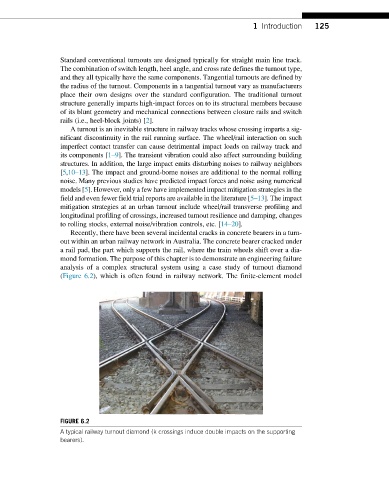
                  mond formation. The purpose of this chapter is to demonstrate an engineering failure
                  analysis of a complex structural system using a case study of turnout diamond
                  (Figure 6.2), which is often found in railway network. The finite-element model


                  FIGURE 6.2
                  A typical railway turnout diamond (k crossings induce double impacts on the supporting
                  bearers).

