


Page 429 - Industrial Wastewater Treatment, Recycling and Reuse
P. 429
Application of Anaerobic Membrane Bioreactor  401


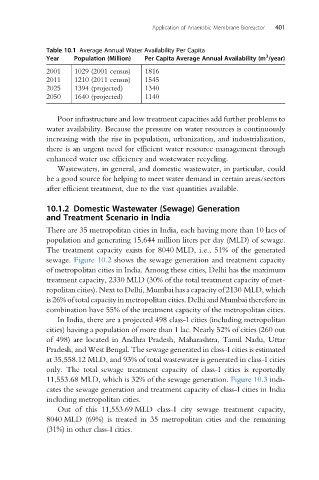
              Table 10.1 Average Annual Water Availability Per Capita
                                                                         3
              Year   Population (Million)  Per Capita Average Annual Availability (m /year)
              2001   1029 (2001 census)  1816
              2011   1210 (2011 census)  1545
              2025   1394 (projected)   1340
              2050   1640 (projected)   1140


                 Poor infrastructure and low treatment capacities add further problems to
              water availability. Because the pressure on water resources is continuously
              increasing with the rise in population, urbanization, and industrialization,
              there is an urgent need for efficient water resource management through
              enhanced water use efficiency and wastewater recycling.
                 Wastewaters, in general, and domestic wastewater, in particular, could
              be a good source for helping to meet water demand in certain areas/sectors
              after efficient treatment, due to the vast quantities available.

              10.1.2 Domestic Wastewater (Sewage) Generation
              and Treatment Scenario in India
              There are 35 metropolitan cities in India, each having more than 10 lacs of
              population and generating 15,644 million liters per day (MLD) of sewage.
              The treatment capacity exists for 8040 MLD, i.e., 51% of the generated
              sewage. Figure 10.2 shows the sewage generation and treatment capacity
              of metropolitan cities in India. Among these cities, Delhi has the maximum
              treatment capacity, 2330 MLD (30% of the total treatment capacity of met-
              ropolitan cities). Next to Delhi, Mumbai has a capacity of 2130 MLD, which
              is 26% of total capacity in metropolitan cities. Delhi and Mumbai therefore in
              combination have 55% of the treatment capacity of the metropolitan cities.
                 In India, there are a projected 498 class-I cities (including metropolitan
              cities) having a population of more than 1 lac. Nearly 52% of cities (260 out
              of 498) are located in Andhra Pradesh, Maharashtra, Tamil Nadu, Uttar
              Pradesh, and West Bengal. The sewage generated in class-I cities is estimated
              at 35,558.12 MLD, and 93% of total wastewater is generated in class-I cities
              only. The total sewage treatment capacity of class-I cities is reportedly
              11,553.68 MLD, which is 32% of the sewage generation. Figure 10.3 indi-
              cates the sewage generation and treatment capacity of class-I cities in India
              including metropolitan cities.
                 Out of this 11,553.69 MLD class-I city sewage treatment capacity,
              8040 MLD (69%) is treated in 35 metropolitan cities and the remaining
              (31%) in other class-I cities.

