


Page 559 - Industrial Wastewater Treatment, Recycling and Reuse
P. 559
Industrial Wastewater Treatment, Recycling, and Reuse—Past, Present and Future  529


                 energy using equipment that is easily maintained and cost effective com-
                 pared to existing treatment methods.
              •  Trained manpower: Trained manpower is essential for the smooth assim-
                 ilation, installation, operation, and maintenance of any technology.
                 Wastewater treatment, recycling, and reuse are interdisciplinary
                 endeavors that require input from chemistry and engineering. In view
                 of the complex ETP of today, training is essential so that plants operate
                 efficiently without cost intensive maintenance and breakdowns. Often, a
                 gap is observed between the plant personnel and the people responsible
                 for instruments and computers. Different groups, often lack good under-
                 standing of each other’s role in the larger operation and in issues such as
                 technological knowledge and software application. A suitable training
                 can help to bridge this gap for smooth plant operation.
              At this juncture, it might be useful to re-examine the knowledge and devel-
              opments resulting from our experience using industrial wastewater treat-
              ment technologies. Despite several advances in various technologies and
              mathematical modelling, present day water treatment still involves a set of
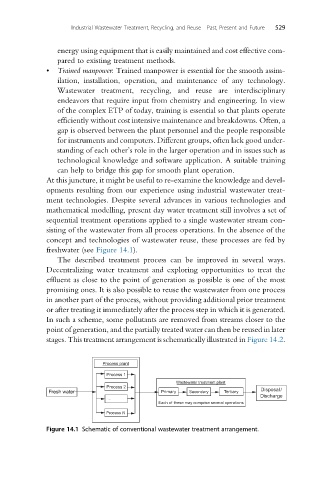
              sequential treatment operations applied to a single wastewater stream con-
              sisting of the wastewater from all process operations. In the absence of the
              concept and technologies of wastewater reuse, these processes are fed by
              freshwater (see Figure 14.1).
                 The described treatment process can be improved in several ways.
              Decentralizing water treatment and exploring opportunities to treat the
              effluent as close to the point of generation as possible is one of the most
              promising ones. It is also possible to reuse the wastewater from one process
              in another part of the process, without providing additional prior treatment
              or after treating it immediately after the process step in which it is generated.
              In such a scheme, some pollutants are removed from streams closer to the
              point of generation, and the partially treated water can then be reused in later
              stages. This treatment arrangement is schematically illustrated in Figure 14.2.


                             Process plant
                              Process 1
                                                 Wastewater treatment plant
                              Process 2
              Fresh water                    Primary  Secondary  Tertiary  Disposal /
                                                                       Discharge
                              ...
                                            Each of these may comprise several operations
                              Process N
              Figure 14.1 Schematic of conventional wastewater treatment arrangement.

