


Page 561 - Industrial Wastewater Treatment, Recycling and Reuse
P. 561
Industrial Wastewater Treatment, Recycling, and Reuse—Past, Present and Future  531


                                                           Bio-energy

                                                      Recovered chemicals

                                                          Recovered metals


                     Wastewater stream                       Bio materials
                                                                 Water


                                                               Fertilizers

                                    Wastewater treatment    Other uses


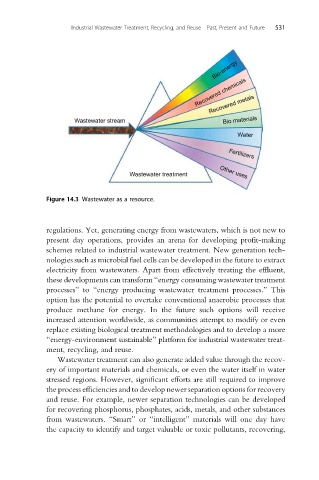
              Figure 14.3 Wastewater as a resource.


              regulations. Yet, generating energy from wastewaters, which is not new to
              present day operations, provides an arena for developing profit-making
              schemes related to industrial wastewater treatment. New generation tech-
              nologies such as microbial fuel cells can be developed in the future to extract
              electricity from wastewaters. Apart from effectively treating the effluent,
              these developments can transform “energy consuming wastewater treatment
              processes” to “energy producing wastewater treatment processes.” This
              option has the potential to overtake conventional anaerobic processes that
              produce methane for energy. In the future such options will receive
              increased attention worldwide, as communities attempt to modify or even
              replace existing biological treatment methodologies and to develop a more
              “energy-environment sustainable” platform for industrial wastewater treat-
              ment, recycling, and reuse.
                 Wastewater treatment can also generate added value through the recov-
              ery of important materials and chemicals, or even the water itself in water
              stressed regions. However, significant efforts are still required to improve
              the process efficiencies and to develop newer separation options for recovery
              and reuse. For example, newer separation technologies can be developed
              for recovering phosphorus, phosphates, acids, metals, and other substances
              from wastewaters. “Smart” or “intelligent” materials will one day have
              the capacity to identify and target valuable or toxic pollutants, recovering,

