


Page 560 - Industrial Wastewater Treatment, Recycling and Reuse
P. 560
530   Industrial Wastewater Treatment, Recycling, and Reuse


           Fresh water  Process 1  Treatment 1
                                          Treatment 3
                      Process 2  Treatment 2
                                                                  Disposal/
            Fresh water  ...                                    discharge/recycle
                                                      Treatment 5
                                                                for non-process
                                                                 applications
                      Process N      Treatment 4
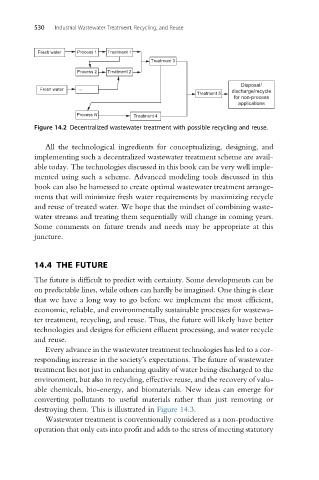
          Figure 14.2 Decentralized wastewater treatment with possible recycling and reuse.

             All the technological ingredients for conceptualizing, designing, and
          implementing such a decentralized wastewater treatment scheme are avail-
          able today. The technologies discussed in this book can be very well imple-
          mented using such a scheme. Advanced modeling tools discussed in this
          book can also be harnessed to create optimal wastewater treatment arrange-
          ments that will minimize fresh water requirements by maximizing recycle
          and reuse of treated water. We hope that the mindset of combining waste-
          water streams and treating them sequentially will change in coming years.
          Some comments on future trends and needs may be appropriate at this
          juncture.


          14.4 THE FUTURE

          The future is difficult to predict with certainty. Some developments can be
          on predictable lines, while others can hardly be imagined. One thing is clear
          that we have a long way to go before we implement the most efficient,
          economic, reliable, and environmentally sustainable processes for wastewa-
          ter treatment, recycling, and reuse. Thus, the future will likely have better
          technologies and designs for efficient effluent processing, and water recycle
          and reuse.
             Every advance in the wastewater treatment technologies has led to a cor-
          responding increase in the society’s expectations. The future of wastewater
          treatment lies not just in enhancing quality of water being discharged to the
          environment, but also in recycling, effective reuse, and the recovery of valu-
          able chemicals, bio-energy, and biomaterials. New ideas can emerge for
          converting pollutants to useful materials rather than just removing or
          destroying them. This is illustrated in Figure 14.3.
             Wastewater treatment is conventionally considered as a non-productive
          operation that only eats into profit and adds to the stress of meeting statutory

