


Page 567 - Instrumentation Reference Book 3E
P. 567
Introduction  549


                                                     p  = 19.3


                 0.01


                 0.005


                                          -
                             ///  I  I  I  A  1
                    0.1    0.2   0.3 0.4 0.50.6 0.8  1   2   3  4  56789
                                       Gamma-ray energy (Mev)
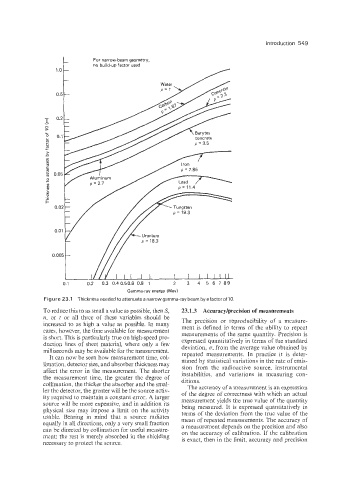
              Figure 23.1  Thickness needed to attenuate a narrow gamma-ray beam byafactor of 10.
              To reduce this to as small a value as possible, then S,   23.1.3  Accuracy/precision of measurements
              17,  or  t  or  all  three  of  these variables should  be   The  precision  or  reproducibility  of a  measure-
              increased to as high  a value as possible.  In many   ment  is defined in terms of the   to repeat
              cases,, however, the time available for measurement   measurements of the Same quantity. Precision is
              is short. This is particularly true on high-speed pro-   expressed qualltitatively  in terms   the standard
              duction lines of  sheet  matel<al, where only  a  few   deviation, ~, from the average value obtained by
              milliseconds may be available for the measurement.   repeated  measurements.  In  practice  it  is  deter-
                It can now be seen how measurement time, col-
              limation, detector size, and absorber thickness may   mined by statistical variations in the rate of emis-
                                                        sion  from  the  radioactive  source,  instrumental
              affect the error in the measurement. The shorter   instabilities, and  variations  in  measuring  con-
              the measurement time, the  greater the  degree of   ditions,
              collimation, the thicker the absorber and the smal-   The accuracy of a measurement is an expression
              ler the detector, the greater will be the source activ-   of the degree of correctness with which an actual
              ity required to maintain a constant error. A larger   measurement yields the tme value of the quantity
              source will be more expensive, and in addition its   being measu.ed,  It is  expressed quantitatively  in
              physical size may  impose a limit  On  the  activity   terms of the deviation from the tme value of the
              usable.  Bearing  in  mind  that  a  source  radiates   meall of repeated measurements. The accuracy of
              equ&  in all directions, only a very small fraction   a measurement depends on the precision and also
              call lbe direcied by collimation for useful measure-   on the accuracy of calibration.  If   calibration
              meat: the rest is merely absorbed in the shielding   is exact, thell  in tile limit, accuracy and precision
              necessary to protect the source.

