


Page 571 - Instrumentation Reference Book 3E
P. 571
Materials analysis  553

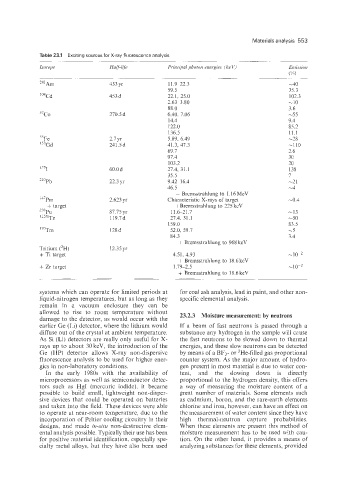
             Table 23.1  Exciting sources for X-ray fluorescence analysis
             Isotopt.            Hay-l{fe         Principal photori  eneFgies  [lie L:i   Eniissioiz
                                                                                      ([YO)
                                 433 yr            11.9-22.3                          -40
                                                  59.5                                35.3
                                 453 d            22.1. 25.0                          102.3
                                                  2.63-3.80                           -10
                                                  88.0                                3.6
             j7c0                170.5 d          6.40. 7.06                          -55
                                                   14.4                               9.4
                                                   122.0                              85.2
                                                   136.5                              11.1
                                 2.7 yr            5.89. 6.49                         -28
                                 241.5d           41.3, 47.3                          -110
                                                  69.7                                2.6
                                                  97.4                                3c
                                                   103.2                              20
                                 60.0 d           17.4, 3 1.1                         138
                                                  35.5                                7
                                 21.3 yr          9.42-1 6.4                          -2  1
                                                  46.5                                -4
                                                     + Bremsstrahlung  to 1.16 MeV
             14'prn              2.623 yr         Characteristic X-rays of target     -0.4
               + target                              +Bremsstrahlung to 225 keV
             23XPU               S7.75yr           1 1.6-2 1.7                        -13
             lrjmTe              119.7  d          27.4, 31.1                         -50
                                                   159.0                              83.5
                                  128d             52.0. 59.7                         -5
                                                   84.3                               3.4
                                                      + Bremsstrahlung  to 968 keV
             Tritium ('H)         12.35yr
             + Ti target                            4.51. 4.93                        -10-2
                                                      + Bremsstrahlung  to 18.6 keV
             + Zr target                            1.79-2.5                          -10-2
                                                      + Bremsstrahlung  to 18.6 keV

             systems which can operate for limited periods at   for coal ash analysis, lead in paint, and other non-
             liquid-nitrogen temperatures, but as long as they   specific elemental analysis.
             remain  in  a  vacuum  enclosure  they  can  be
             allowed  to  rise  to  room  temperature  without   23.2.3  Moisture measurement: by neutrons
             damage to the detector, as would occur with the
             earlier Ge (Ei) detector, where the lithium would   If  a beam  of  fast  neutrons  is  passed  through  a
             diffuse out of the crystal at ambient temperature.   substance any hydrogen in the sample will cause
             As Si (La) detectors are really only useful for X-   the fast  neutrons  to be  slowed down to thermal
             rays up to about 30keV, the introduction  of the   energies, and these slow neutrons can be detected
             Ge  (HP) detector  alllows  X-ray  non-dispersive   by means of a BF3- or 3He-filled gas proportional
             fluorescence analysis to be used for higher ener-   counter system. As the major  amount of  hydro-
             gies in non-laboratory  conditions.      gen present in most material is due to water con-
               In  the  early  1980s  with  the  availability  of   tent,  and  the  slowing  down  is  directly
             microprocessors  as well as semiconductor detec-   proportional to the hydrogen density, this offers
             tors  such  as  HgI  (mercuric  iodide),  it  became   a  way  of  measuring  the  moisture  content  of  a
             possible  to  build  small,  lightweight  non-disper-   great  number  of  materials.  Some elements such
             sive 'devices that  could  be  operated  on batteries   as cadmium, boron, and the rare-earth  elements
             and itaken into the field. These devices were able   chlorine and iron, however, can have an effect on
             to operate at near-room  temperature,  due to the   the measurement of water content since they have
             incorporation  of Peltier cooling circuitry in their   high  thermal-neutron  capture  probabilities.
             designs.  and  made  In-situ  non-destructive  elem-   When  these elements are present  this method  of
             ental analysis possible. Typically their use has been   moisture measurement  has to be  used  with cau-
             for positive material identification, especially spe-   tion. On the other hand, it  provides  a means  of
             cialty metal  alloys, but  they have also been used   analyzing substances for these elements, provided

