


Page 575 - Instrumentation Reference Book 3E
P. 575
Materials analysis 557
            without  disturbing  the  source.  Steam  tracing  or   in powder form is extracted from the main stream
            electrical  heating  can  be  arranged  for  samples   by a screw conveyor and fed into a hopper. In the
            likely to freeze. The output of the high-resolution   powder-presentation  unit the powder is extracted
            propo'rtional counter, capable of high count rates   from  the  hopper  and fed  on  to a  continuously
            for statistical accuracy. is amplified and applied to   weighted sample presenter at a rate which is con-
            a  counter  and  digital-to-analog  converter  when   trolled so as to maintain a constant mass of sam-
            required.  Thus  both  digital  and  analog  outputs   ple per  unit  area  on the latter  within  very close
            are available for display and control purposes.   limits. After measurement, the sample is returned
              The meter  has  a  range  of  up  to  0-6  percent   to the process. A  system is  fitted  to  provide  an
            sulfur  by  weight  and  indicates  with  a  precision   alarm if the mass per unit area of sample wanders
            of TtO.01 percent  sulfur by weight or &l percent   outside preset  limits. and aspiration  is provided
            of the indicated weight, whichever is the larger. It   to eliminate airborne  dust in the vicinity of  the
            is independent of carbon-hydrogen ratio from 6: 1   sample presenter and measuring head.
            to 10:1 and the integrating times are from 10 to   Under  these conditions it  is possible to make
            200 s. The flow cell is suitable for pressures up to   precise reproducible X-ray fluorescence measure-
            15 bar and temperatures up to  15O"C, the tem-   inents  of  elements  from  atomic  number  19
            perature  range  for the  electronics being  -10  to   upwards without pelletizing.
            +45 "IC.                                   The signal from the X-ray detector in the pow-
              The arrangement of the instrument is as shown   der-presentation  unit  is  transmitted  via  a  head
            in Figure 23.8.                           amplifier  and  a  standard  nucleonic  counting
                                                     chain  to  a  remote  display  and  control  station.
                                                     Analog outputs can be provided for control pur-
            23.2.5  The radioisotope calcium monitor
                                                     poses.
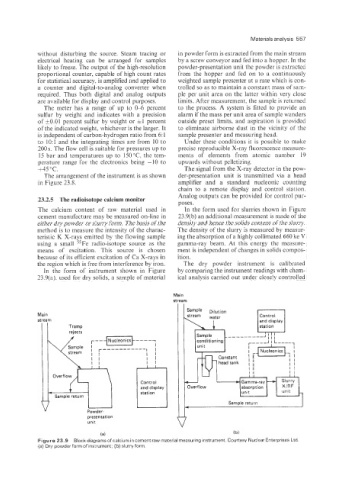
            The  calcium  content  of  raw  material  used  in   In the form used for slurries shown in  Figure
            cement manufacture may be measured  on-line in   23.9(b) an additional measurement is made of the
            either dry powder or slurry form. The basis of the   density and hence the solids content of the slurry.
            method is to measure the intensity of the charac-   The density of the slurry is measured by measur-
            teristic K X-rays  emitted by the flowing sample   ing the absorption of a highly collimated 660 ke V
            using  a  small  j'Fe  radio-isotope  source  as  the   gamma-ray  beam.  At  this  energy  the  measure-
            meanis  of  excitation.  This  source  is  chosen   ment is independent of changes in solids CO~~QS-
            because of its efficient excitation of Ca X-rays in   itioii.
            the region which is free from interference by iron.   The  dry  powder  instrument  is  calibrated
              In  the  form  of  instrument  shown  iii  Figure   by comparing the instrument readings with chem-
            23.9(a). used for dry solids, a sample of material   ical analysis carried  out under  closely controlled


                                                    Main

            Main
            !  B m
                     Tramp
                      rejects
                \


                           Powder-
                           presentation
                           unit

                               (a)
             Figure 23.9   Block diagrams of  calcium in cement raw material measuring instrument. Courtesy Nuclear Enterprises Ltd
             (a) Dry powder form of instrumen:;  (b) slurry form.

