


Page 577 - Instrumentation Reference Book 3E
P. 577
Detector =                             Mechanical measurements  559


                                                     portable box, have been made to detect the level
                                                     of liquid COz in high-pressure cylinders. This is a
                             Detector  (high level)
                                                     much  simpler method  than that  of weighing the
                                                     cylinder  and  subtracting  this  value  from  the
                                            Control
                                                     weight when the cylinder was originally received.
                                   (low
                                      level)
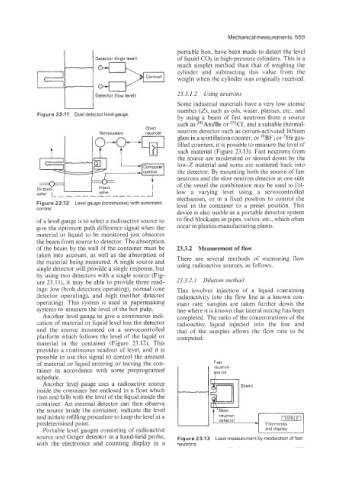
                                                     23.3.1.2  Using neutrons
                    u                                Some industrial materials have a very low atomic
            Figure 23.11  Dual detector level gauge.   number (9, such as oils. water, plastics, etc., and
                                                     by  using a beam of  fast neutrons  from  a  source
                                                     such as l4lAmlBe or 25ZCf, and a suitable thermal-
                                            Chart
                              Servosystem   recorder   neutron detector such as cerium-activated lithium
                                                     glass in a scintillation counter, or "BF;  or 3He gas-
                                                     filled counters, it is possible to measure the level of
                                                     such material (Figure 23.13). Fast neutrons  from
                                                     the source are moderated or slowed down by the
                                                     low-Z material and some are scattered back into
                                                     the detector. By mounting both the source of fast
                                                     neutrons and the slow neutron detector at one side
                                                     of the vessel the combination may be used to fol-
                                                     low  a  varying  level  using  a  servocontrolled
                                                     mechanism, or in a fixed  position to control the
            Figurc 23.12  Level gauge (continuous) with automatic   level  in  the  container  to  a  preset  position.  This
            control.
                                                     device is also usable as a portable detector system
            of a level gauge is to select a radioactive source to   to find blockages in pipes. valves, etc., which often
            give the optimum path difference signal when the   occur in plastics-manufacturing plants.
            material or liquid to be monitored just  obscures
            the beam from source to detector. The absorption
            of the beam by the wall of the container must be   23.3.2  Measurement of flow
            taken  into account,  as well as the absorption  of
            the material being measured. A single source and   There  are  several  methods  of  measuring  flow
                                                     using radioactive sources, as follows.
            single detector will provide a single response, but
            by using two detectors with a single source (Fig-
            ure 23.1 l), it may be able to provide three read-   23.3.2.1  Dilution nietlzod
            ings: low (both detectors operating), normal (one   This  involves  injection  of  a  liquid  containing
            detector  operating),  and  high  (neither  detector   radioactivity  into the flow line at a known  con-
            operating). This  system is  used in  papermaking   stant  rate:  samples are  taken  further  down  the
            systems to measure the level of the hot pulp.   line where it is known that lateral mixing has been
              Another level gauge to give a continuous indi-   completed. The ratio of the concentrations of the
            cation  of material or liquid level has the detector   radioactive  liquid  injected  into  the  line  and
            and  the  source  mounted  on  a  servocontrolled   that  of  the  samples allows  the  flow  rate  to  be
            platform which follows the level of the liquid or   computed.
            material  in  the  container  (Figure 23.12).  This
            provides a continuous readout  of  level, and it is
            possible to use this signal to control the amount
            of material or liquid entering or leaving the con-   Fast
            tainer  in  accordance  with  some  preprogramed    neutron
                                                                source
            schedule.
              Another  level  gauge uses  a  radioactive  source        Shield
            inside the container but enclosed in a float which
            rises and falls with the level of the liquid inside the
            container. An external detector can then  observe
            the source inside the container, indicate the level
            and initiate refilling procedure to keep the level at a
            predetermined point.                                               Electronics
              Portabie level gauges consisting of radioactive                  and display
            source and Geiger detector in a hand-held probe,   Figure 23.13  Level measurement by moderation of fast
            with  ithe  electronics  and  counting  display  in  a   neutrons.

