


Page 582 - Instrumentation Reference Book 3E
P. 582
564  Measurements employing nuclear techniques

             two  soft beta  particles  (Emax = 0.156MeV), one   Anthracite  coal,  with  an  estimated  age  of
             can appreciate that the counting is, indeed, very   2 x  lo9 yr, can be used to provide  the dead car-
             “low-level.’’  The   natural   counting   rate   bon background. Corrections must also be made
             (unshielded) of a typical gas proportional counter   for isotopic fractionation which can occur both in
              15 cm diameter x 60 cm long would be some 75.6   nature and during the various chemical proced-
             counts  per  second,  whereas  the  signal  due  to   ures used in preparing the sample.
              1 atm  of  live  modern  CO?  or  CH4  filling  the
             counter would be only 0.75 count per second. In   Statistics  of  carbon  dating  The  standard devi-
             order to achieve a standard deviation of 1 percent   ation  u of  the source count rate when corrected
             in  the  measurement,  10,000 counts would  have   for background is given by
             to  be  measured,  and  at  the  rate  of  0.75 count
             per second the measurement would take 3.7 days.
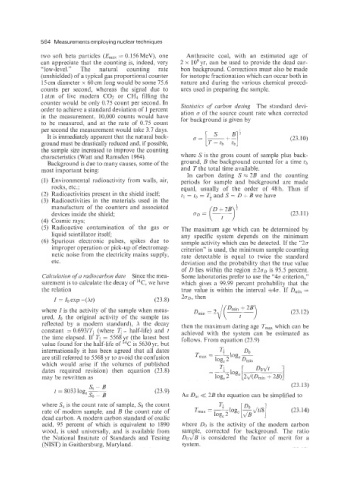
               It is immediately apparent that the natural back-                       (23.10)
             ground must be drastically reduced and, if possible,
             the sample size increased to improve the counting
             characteristics (Watt and Ramsden 1964).   where S is the gross count of  sample plus back-
               Background is due to many causes; some of the   ground, B the background counted for a time tb
             most important being:                     and T the total time available.
                                                         In  carbon  dating  S N 2B  and  the  counting
             (1)  Environmental  radioactivity  from walls,  air,   periods  for  sample  and  background  are  made
                rocks, etc.;                           equal,  usually  of  the  order  of  48h.  Thus  if
             (2)  Radioactivities present in the shield itself;   tl  = tb = TL and S = D + B we have
             (3)  Radioactivities  in  the  materials  used  in  the
                manufacture  of  the  counters  and associated
                devices inside the shield;                                             (23.1 1)
              (4)  Cosmic rays;
              (5)  Radioactive  contamination  of  the  gas  or   The maximum  age which can be  determined  by
                liquid scintillator itself;            any  specific  system  depends  on  the  minimum
              (6)  Spurious  electronic  pulses,  spikes  due  to   sample activity which can be detected. If the “2g
                 improper operation or pick-up of electromag-   criterion” is used, the minimum sample counting
                netic noise from the electricity mains supply,   rate  detectable  is  equal  to  twice  the  standard
                 etc.                                  deviation  and the probability that the true value
                                                       of D lies within the region &20D is 95.5 percent.
              Calculation of a radiocarbon date  Since the mea-   Some laboratories prefer to use the “4u criterion,”
              surement is to calculate the decay of 14C, we have   which  gives  a  99.99  percent probability  that the
              the relation                             true value is  within  the  interval  k4u. If  Dmin =
                                                       200, then
                 I  = I, exp -(At)             (23.8)
              where I is the activity of the sample when meas-                         (23.12)
              ured,  IO the  original  activity  of  the  sample  (as
              reflected  by  a  modern  standard),  A  the  decay   then the maximum dating age Tmax which can be
              constant  = 0.693/T~ (where  rri=  half-life)  and  t   achieved  with  the  system  can  be  estimated  as
              the time elapsed. Ir‘ T; = 556dyr (the latest  best   follows. From equation (23.9)
              value found for the half-life of 14C is 5630 yr, but
              internationally it  has  been  agreed that  all dates
              are still referred to 5568 yr to avoid the confusion
              which  would  arise  if  the  volumes  of  published
              dates  required  revision)  then  equation  (23.8)
              may be rewritten as
                            S, - B                                                     (23.13)
                 t = 8033 log, __              (23.9)
                           So  - B                     As D,,, <( 2B the equation can be simplified to
              where S, is the count rate of sample, SO the count
              rate  of  modern  sample, and B the count  rate of
              dead carbon. A modern carbon standard of oxalic
              acid,  95  percent  of  which  is  equivalent  to  1890   where  DO is  the  activity  of  the  modern  carbon
              wood,  is  used universally, and is  available from   sample,  corrected  for  background.  The  ratio
              the  National  Institute  of  Standards  and  Testing   DoJB  is  considered  the  factor  of  merit  for  a
              (NIST) in Gaithersburg, Maryland.        system.

