


Page 583 - Instrumentation Reference Book 3E
P. 583
References  565

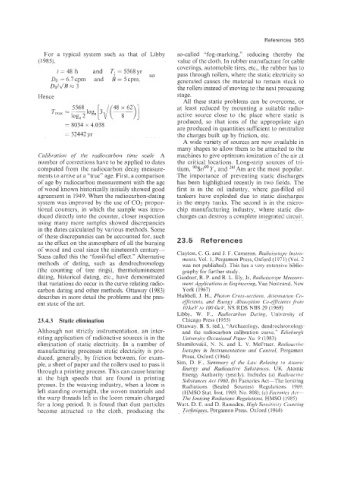
              For  a  typical  system  such  as  that  of  Libby   so-called  "fog-marking,"  reducing  thereby  the
             (1985).,                                 value of the cloth. In rubber manufacture for cable
                                                      coverings, automobile tires. etc., the rubber has to
                  t =48 h    and  T; = 5568yr   so    pass through rollers, where the static electricity so
                Do = 6.7 cpm   and   = 5 cpm,         generated causes the material to remain stuck to
                DolJB  M 3                            the rollers instead of moving to the next processing
             Hence                                    stage.
                                                       All these static problems can be overcome, or
                                                      at  least  reduced  by  mounting  a  suitable radio-
                                                      active  source  close  to  the place  where  sfatic  is
                                                      produced,  so  that  ions  of  the  appropriate sign
                     = 8034 x 4.038                   are produced in quantities sufficient to neutralize
                    = 32442yr                         the charges built up by friction, etc.
                                                       A wide variety of sources are now available in
                                                      many shapes to allow them to be attached to the
             Calibvation  of  the  radiocarbon  time  scale  A   machines to give optimum ionization of the air at
            number of corrections have to be applied to dates   the  critical  locations.  Long-strip  sources  of  tri-
            computed from the radiocarbon  decay measure-   tium, 9oSr190  Y, and 241Am are the most popular.
            ments to arrive at a "true" age. First, a comparison   The  importance  of  preventing  static  discharges
            of age by radiocarbon measurement with the age   has been  highlighted recently in two  fields. The
             of wood known historilzally initially showed good   first  is  in  the  oil  industry,  where  gas-filled oil
            agreement in 1949. Wh.en the radiocarbon-dating   tankers  have  exploded  due  to  static  discharges
            system was improved by the use of CO? propor-   in the empty  tanks.  The  second is in the micro-
            tional  counters; in  which the  sample was intro-   chip  manufacturing  industry,  where  static  dis-
            duced directly into the counter, closer inspection   charges can destroy a complete integrated circuit.
            using many more  samples showed discrepancies
            in the dates calculated by various methods. Some
            of these discrepancies can be accounted for, such
             as the effect on the atmosphere of all the burning   23.5  References
            of wolod and coal since the nineteenth  century-
             Suess #called this the "fossil-fuel effect." Alternative   Clayton, C. G. and J. F. Cameron. Radioisotope Instru-
            methods  of  dating,  such  as  dendrochronology   nzents, Vol. 1, Pergamon Press, Oxford (1971) (Vol. 2
                                                       was not published).  This has a very extensive biblio-
            (the  counting  of  tree  rings),  thermoluminescent   graphy for further study.
            dating,  historical  dating, etc., have  demonstrated   Gardner, R. P. and R. L. Ely, Jr, Radioisotope Measure-
            that variations do occur in the curve relating radio-   ment Applications in Engineering,  Van Nostrand. New
            carbon dating and other methods. Ottaway (1983)   York (1967)
            describes in more detail the problems and the pres-   Hubbell, J. H., Photon Cross-sections, Attenuation  Co-
            ent state of the art.                      efficients,  and  Energy  Absorption  Co-efficients fioni
                                                       lOkeVtolOOGeV,NSRDSNBS29(1969)
                                                      Libby,  W.  F.,  Radiocarbon  Dating,  University  of
            23.4.3  Static elimination                 Chicago Press (1955)
                                                      Ottaway, B. S. (ed.); "Archaeology, dendrochronology
            Although  not  strictly instrumentation,  an inter-   and  the  radiocarbon  calibration curve."  Edihburgh
            esting application of radioactive sources is in the   University Occasional Paper No. 9 (1983)
            elimination  of  static electricity. In  a  number  of   Shumilovskii. N.  N. and L. V.  Mel'ttser,  Radioactive
            manufacturing  processes static electricity is pro-   Isotopes  in  Instrumentation  and  Control, Pergamon
            duced, generally, by friction  between, for exam-   Press, Oxford (1964)
            ple, a sheet of paper and the rollers used to pass it   Sim, D. F., Summary  of  the  Laiv  Relating  to  Atoniic
            throu,gh a printing process. This can cause tearing   Energy  and  Radioactive  Substances:  UK  Atomic
            at  the  high  speeds  that  are  found  in  printing   Energy  Authority  (yearly). Includes  (a) Radioactive
                                                       Sz~bstances Act 1960, (b) Factories Act-The  Ionizing
            presses. In the weaving industry, when a loom is   Radiations  (Sealed  Sources)  Regulations  1969.
            left standing overnight, the woven materials and   (HMSO Stat. Inst. 1969, No. 808); (c) Factories Act-
            the warp threads left in the loom remain charged   The Ionisilzg Radiations Regulations, HMSO (1985)
            for a iong period. It is found  that dust particles   Watt, D. E. and D. Ramsden, High Sensitivitj' Counting
            become  attracted  to  the  cloth,  producing  the   Techniques, Pergamon Press. Oxford (1964)

