


Page 585 - Instrumentation Reference Book 3E
P. 585
Surface-inspection methods  567

                                 Ultrasonics            Electrical
            y-rays                                      resistivity


                     screen intensifier
           Figure 24.2  NDT methods for sub-surface inspection.

           24.2  Visual examination

           For many types of components, integrity is verified
           principally through visual inspection. Indeed, even
           for  components  that  require  further  inspection
           using ultrasonics or radiography visual inspection
           still  constitutes an  important  aspect  of  practical
           quality control.
            Visual inspection is  the most  extensively used
           of any method.  It is relatively easy to apply and
           can  have  one  or more  of  the  following advan-
           tages:
           (1)  Low cost;
           (2) Can be applied while work is in progress;
           (3) Allows early correction of faults;
           (4) Gives indication of incorrect procedures;
           (5)  Gives  early  warning  of  faults  developing
             when item is in use.

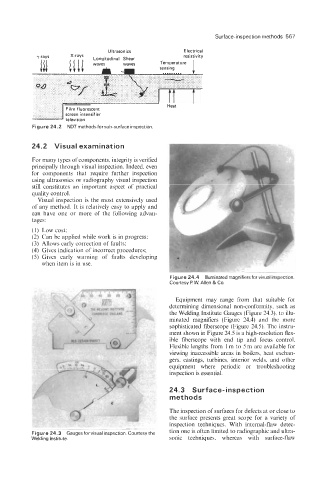
                                                    Figure 24.4  Illuminated magnifiersfor visual inspection.
                                                    Courtesy P.W. Allen & Co.

                                                     Equipment  may  range  from  that  suitable  for
                                                    determining dimensional non-conformity, such  as
                                                    the Welding Institute Gauges (Figure 24.3), to illu-
                                                    minated  magnifiers (Figure  24.4) and  the  more
                                                    sophisticated fiberscope (Figure 24.5). The instru-
                                                    ment shown in Figure 24.5 is a high-resolution flex-
                                                    ible  fiberscope with  end  tip  and  focus  control.
                                                    Flexible lengths from  1 m to 5 m are available for
                                                    viewing inaccessible areas in  boilers,  heat exchan-
                                                    gers,  castings, turbines, interior welds,  and  other
                                                    equipment  where  periodic  or  troubleshooting
                                                    inspection is essential.

                                                    24.3  Surface-inspection
                                                    methods
                                                   The inspection of surfaces for defects at or close to
                                                    the  surface presents great  scope for  a  variety  of
                                                    inspection  techniques.  With  internal-flaw detec-
           ~i~~~~ 24.3  ~~~~~~f~~   inspection, courtesy the   tion one is often limited to radiographic and ultra-
          Welding Institute.                        sonic  techniques,  whereas  with  surface-flaw

