


Page 590 - Instrumentation Reference Book 3E
P. 590
572  Non-destructive testing

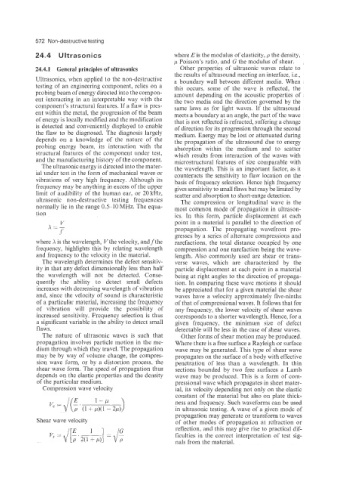
            24.4  Ultrasonics                        where E is the modulus of elasticity, p the density,
                                                     ,LL  Poisson’s ratio, and G the modulus of shear.
            24.4.1  General principles of ultrasonics   Other  properties  of  ultrasonic  waves  relate to
                                                     the results of ultrasound meeting an interface, Le.,
            Ultrasonics,  when applied to the non-destructive   a  boundary wall between different media. When
            testing of  an engineering component, relies on a   this  occurs,  some  of  the  wave  is  reflected,  the
            probing beam of energy directed into the compon-   amount  depending on  the  acoustic properties  of
            ent  interacting in  an interpretable q7ay  with  the   the two media and the direction governed by the
            component’s structural features. If  a flaw is pres-   same laws  as  for  light  waves.  If  the  ultrasound
            ent within the metal, the progression of the beam   meets a boundary at an angle, the part of the wave
            of energy is locally modified and the modification   that is not reflected is refracted, suffering a change
            is detected and conveniently displayed to enable   of direction for its progression through the second
            the flaw to be  diagnosed.  The  diagnosis largely   medium. Energy may be lost or attenuated during
            depends  on  a  knowledge  of  the  nature  of  the   the propagation  of  the ultrasound  due to energy
            probing  energy  beam,  its  interaction  with  the   absorption  within  the  medium  and  to  scatter
            structural  features  of the component under  test,   which results from interaction  of  the waves with
            and the manufacturing history of the component.   microstructural  features of  size comparable with
              The ultrasonic energy is directed into the mater-   the wavelength. This is an important factor, as it
            ial under test in the form of mechanical waves or   counteracts the sensitivity to flaw location on the
            vibrations  of  very  high  frequency.  Although  its   basis of frequency selection. Hence high frequency
            frequency may be anything in excess of the upper   gives sensitivity to small flaws but may be limited by
            limit  of  audibility  of  the human ear, or 20 kHz,   scatter and absorption to short-range detection.
            ultrasonic  non-destructive  testing  frequencies   The  compression  or longitudinal  wave  is  the
            normally lie in the range 0.5-10MHz.  The equa-   most common mode of propagation  in ultrason-
            tion                                     ics.  In  this  form,  particle  displacement  at  each
                   V                                 point in a material is parallel to the direction of
                A=-                                  propagation.  The  propagating  wavefront  pro-
                   f                                 gresses by a series of alternate compressions and
            where X is the wavelength, Vthe velocity, andfthe   rarefactions,  the  total  distance  occupied by  one
            frequency, highlights this by  relating wavelength   compression and one rarefaction being the wave-
            and frequency to the velocity in the material.   length. Also commonly used are shear or trans-
              The wavelength determines the defect sensitiv-   verse  waves,  which  are  characterized  by  the
            ity in that any defect dimensionally less than half   particle displacement at each point in a material
            the  wavelength  will  not  be  detected.  Conse-   being at right angles to the direction of propaga-
            quently  the  ability  to  detect  small  defects   tion. In comparing these wave motions it should
            increases with decreasing wavelength of vibration   be appreciated that for a given material the shear
            and, since the velocity of  sound is characteristic   waves have a velocity approximately five-ninths
            of a particular material, increasing the frequency   of that of compressional waves. It follows that for
            of  vibration  ~7ill provide  the  possibility  of   any frequency, the lower velocity of shear waves
            increased sensitivity. Frequency selection is thus   corresponds to a shorter wavelength. Hence, for a
            a significant variable in the ability to detect small   given  frequency,  the  minimum  size  of  defect
            flaws.                                   detectable will be less in the case of shear waves.
              The  nature  of  ultrasonic  waves  is  such  that   Other forms of shear motion may be produced.
            propagation  involves particle  motion in  the me-   Where there is a free surface a Rayleigh or surface
            dium through which they travel. The propagation   wave may be generated. This type of shear wave
            may be by  way of  volume change, the compres-   propagates on the surface of a body with effective
            sion wave form,  or by  a  distortion  process, the   penetration  of  less  than  a  wavelength.  In  thin
            shear wave form. The speed of propagation  thus   sections  bounded  by  two  free  surfaces  a  Lamb
            depends on the elastic properties and the density   wave may  be produced.  This is a form of  com-
            of the particular medium.                pressional wave which propagates in sheet mater-
              Compression wave velocity              ial, its velocity depending not only on the elastic
                                                     constant  of the material but also on plate thick-
                                                     ness and frequency. Such waveforms can be used
                                                     in ultrasonic testing. A wave of a given mode of
                                                     propagation may generate or transform to waves
            Shear wave velocity                      of  other modes  of  propagation  at refraction  or
                                                     reflection, and this may give rise to practical dif-
                                                     ficulties in the correct  interpretation  of  test  sig-
                                                     nals from the material.

