


Page 588 - Instrumentation Reference Book 3E
P. 588
570  Non-destructive testing


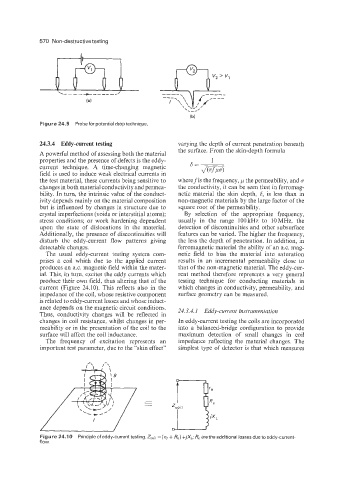
             Figure 24.9  Probe for potential drop technique.


             24.3.4  Eddy-current testing             varying the depth of current penetration  beneath
             A powerful method of assessing both the material   the surface. From the skin-depth formula
             properties and the presence of defects is the eddy-   5=--------  1
             current  technique.  A  time-changing  magnetic   drn
             field is used to induce weak electrical currents in
             the test material, these currents being sensitive to   wherefis  the frequency, p the permeability, and 0
             changes in bothmaterial conductivity and permea-   the conductivity, it can be seen that in ferromag-
             bility. In turn, the intrinsic value of the conduct-   netic material  the  skin  depth,  6, is  less than  in
             ivity depends mainly on the material composition   non-magnetic materials by the large factor of the
             but  is influenced by  changes in structure due to   square root of the permeability.
             crystal imperfections (voids or interstitial atoms);   By  selection  of  the  appropriate  frequency,
             stress conditions;  or work  hardening  dependent   usually  in  the  range  lOOkHz  to  lOMHz,  the
             upon  the  state  of  dislocations  in  the  material.   detection of discontinuities and other subsurface
             Additionally,  the presence of discontinuities will   features can be varied. The higher the frequency,
             disturb  the  eddy-current  flow  patterns  giving   the less the depth of penetration.  In addition, in
             detectable changes.                      ferromagnetic material the ability of an a.c. mag-
               The  usual  eddy-current  testing  system  com-   netic  field  to  bias  the  material  into  saturation
             prises  a  coil  which  due  to  the  applied  current   results  in  an  incremental  permeability  close  to
             produces an a.c. magnetic field within the mater-   that of the non-magnetic material. The eddy-cur-
             ial. This, in turn, excites the eddy currents which   rent  method  therefore  represents a  very  general
             produce their own field, thus altering that of the   testing  technique  for  conducting  materials  in
             current  (Figure  24.10).  This  reflects also  in  the   which changes in conductivity, permeability, and
             impedance of the coil, whose resistive component   surface geometry can be measured.
             is related to eddy-current losses and whose induct-
             ance depends on the magnetic circuit conditions.   24.3.4.1  Eddy-current  instrumentation
             Thus,  conductivity  changes  will  be  reflected in
             changes in coil resistance, whilst changes in per-   In eddy-current testing the coils are incorporated
             meability or in the presentation  of the coil to the   into a balanced-bridge configuration  to provide
             surface will affect the coil inductance.   maximum  detection  of  small  changes  in  coil
               The  frequency  of  excitation  represents  an   impedance  reflecting the  material  changes. The
             important test parameter, due to the “skin effect”   simplest type of  detector  is that which measures


             Figure 24.10  Principle of  eddy-current testing. Z,,i,  =(ro + R,)+jx~; Re are the additional losses due to eddy-current-
             flow.

