


Page 587 - Instrumentation Reference Book 3E
P. 587
Surface-inspection methods  569
                                              ------  -- -
                                             <              I
                       0 (JB
                     Current flow            r
                                                 /
                                                 Coil


                    Threading bar


                                                    I
                                                   Electromagnet
             Figure! 24.7  Waysof inducing flux

             rectified current produced by diode rectification.   unwound  and played  through  a tape unit,  which
             Differ1:nces  in  the type  of  current  used  become   detects the presence of the recorded flux leakages.
             apparent when assessing the “skin depth” of the   For more dynamic situations, such as in the on-
             magnetic  field.  For  a.c.  current  in  a  magnetic   line  testing  of  tube  and  bar  materials,  a  faster
             conductor, magnetic  field  penetration,  even  at   detection  technique  for the  recording  of  indica-
             50Hz. is  limited; the d.c. component  present  in   tions is required. A small detector head, compris-
             the half-wave rectified current produces a greater   ing a highly permeable yoke on which a number
             depth of penetration.                    of turns of wire are wrapped, can be used to detect
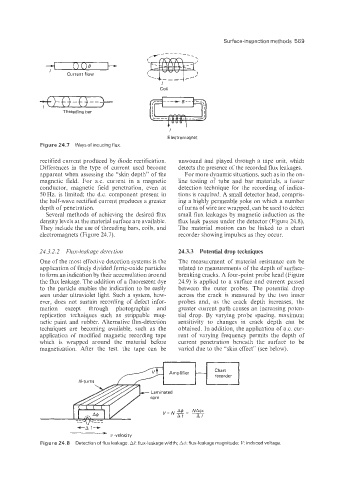
               Sev’eral methods  of  achieving the desired flux   small flux leakages by magnetic induction  as the
             density levels at the material surface are available.   flux leak passes under the detector (Figure 24.8).
             They include the use of threading bars, coils, and   The  material  motion  can  be  linked  to  a  chart
             electromagnets (Figure 24.7).            recorder showing impulses as they occur.

             24.3.2.2  Flux-leakage detection         24.3.3  Potential drop techniques
             One of the most effective detection systems is the   The  measurement  of  material  resistance can  be
             application of finely divided ferric-oxide particles   related to measurements of the depth of  surface-
             to form an indication by their accumulation around   breaking cracks. A four-point probe head (Figure
             the flux leakage. The addition of a fluorescent dye   24.9) is  applied  to  a surface and current  passed
             to the particle enables the indication to  be  easily   between  the  outer  probes.  The  potentiai  drop
             seen under  ultraviolet light. Such a system, how-   across  the  crack  is  measured  by  the  two  inner
             ever, does not  sustain  recording of  defect infor-   probes  and,  as  the  crack  depth  increases.  the
             mation   except  through  photographic  and   greater current path causes an increasing poten-
             replication  techniques  such  as  strippable  mag-   tial  drop. By  varying  probe  spacing, maximum
             netic paint  and rubber. Alternative flux-detection   sensitivity  to  changes  in  crack  depth  can  be
             techniques  are  becoming  available,  such  as  the   obtained. In addition, the application of a.c. CUI-
             application  of  modified magnetic recording tape   rent  of  varying  frequency  permits  the  depth of
             which  is  wrapped  around  the  material  before   current  penetration  beneath  the  surface  to  be
             magnetization.  After  the  test,  the  tape  can  be   varied due to the “skin effect” (see below).


                                              Laminated
                                              core


                        -+-A   1-*
                                m-  v -velocity
             Figure 24.8  Detection of flux leakage. A/. flux-leakage widlh; A$: flux-leakage magnltude; V induced voltage

